
Celebrating Goddess Lakshmi, the Festival of Lights and the enduring triumph of hope over darkness
By Publisher Ray Carmen
Across the world, millions of homes will soon glow with the gentle light of oil lamps, candles and colourful decorations as families prepare to celebrate Deepavali 2026 — the Festival of Lights.
This year, the principal Deepavali celebration, including Lakshmi Puja, falls on Sunday, 8 November 2026, with festivities beginning earlier in the week.
From the magnificent temples of India to the vibrant communities of Trinidad and Tobago, Guyana, Mauritius, Sri Lanka, Britain and beyond, Deepavali remains one of the world’s most beautiful and meaningful religious celebrations.
At its heart lies a message that transcends borders and generations:
Light will triumph over darkness. Knowledge will overcome ignorance. And hope will always have a place in the human heart.
THE GODDESS LAKSHMI — A SYMBOL OF PROSPERITY
Central to Deepavali celebrations in many Hindu traditions is Goddess Lakshmi, revered as the goddess of wealth, prosperity, good fortune and abundance.
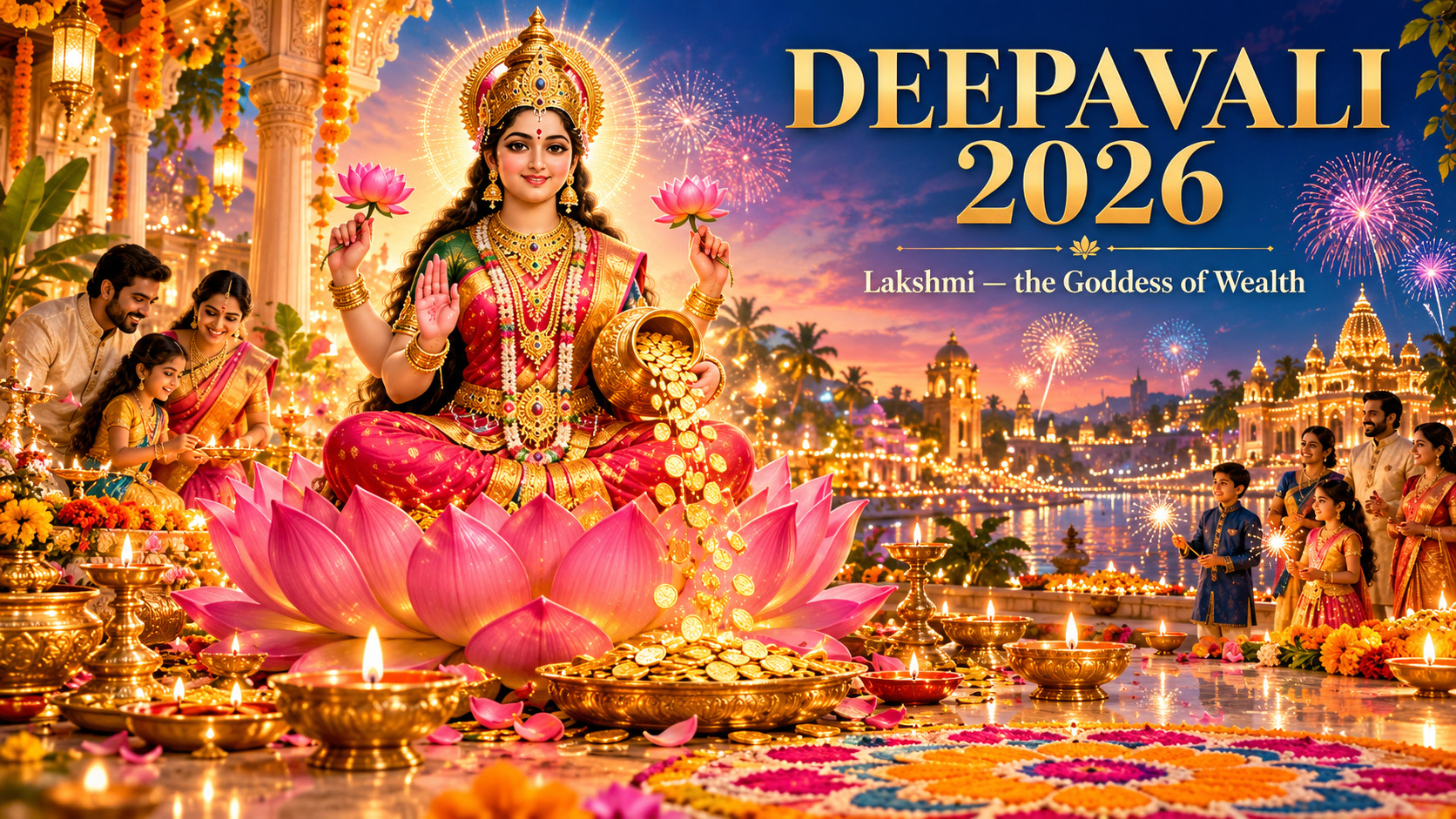
Beautifully depicted seated upon a pink lotus, adorned with golden jewellery and surrounded by radiant light, Lakshmi represents far more than material riches.
Her blessings are associated with spiritual wellbeing, generosity, harmony, good character and the responsible use of prosperity.
The lotus upon which she sits is particularly significant. Rising from muddy waters to blossom in beauty, it symbolises purity, spiritual growth and the ability to remain virtuous despite life’s difficulties.
The gold coins often shown flowing from her hands represent abundance and generosity.
Her raised hand offers blessings, reassurance and protection.
For devotees, welcoming Lakshmi into the home is therefore not simply an invitation to become wealthy. It is an aspiration to live with gratitude, dignity, kindness and wisdom.
WHY DO WE CELEBRATE DEEPAVALI?
The word Deepavali comes from Sanskrit and is commonly understood to mean a row of lights.
The festival has several religious and regional traditions.
In northern India, many Hindus associate Deepavali with the return of Lord Rama, Goddess Sita and Lakshmana to Ayodhya following Rama’s victory over Ravana.
In other traditions, the festival commemorates Lord Krishna’s victory over Narakasura.
For many families, Lakshmi Puja is the spiritual centre of the celebrations.
Although customs differ, these traditions share a powerful theme: the triumph of righteousness, renewal and light.
Deepavali is also celebrated in distinct ways by Jains, Sikhs and some Buddhist communities, each with their own historical and religious significance.
DEEPAVALI 2026 — THE FESTIVAL DATES
In 2026, the principal dates observed in Britain include:
Friday, 6 November — Dhanteras: The beginning of the festive period for many Hindu families, associated with auspicious purchases, wellbeing and preparations for prosperity.
Saturday, 7 November — Naraka Chaturdashi: A day associated with the triumph of good over evil in several Hindu traditions.
Sunday, 8 November — Deepavali and Lakshmi Puja: The principal Festival of Lights celebration, when families illuminate their homes and offer prayers.
Monday, 9 November — Govardhan Puja: Observed in many communities, with traditions varying by region.
Tuesday, 10 November — Bhai Dooj: A celebration of the bond between brothers and sisters.
Dates for some associated observances vary according to regional calendars and religious traditions.
THE CARIBBEAN — WHERE DEEPAVALI SHINES BRIGHTLY
Deepavali holds a particularly special place in the Caribbean.
In Trinidad and Tobago, Divali is one of the country’s most cherished religious and cultural celebrations.
Homes, temples and public spaces are illuminated with thousands of small clay lamps known as diyas.
Families gather for prayers, prepare traditional vegetarian dishes and sweets, and welcome neighbours and friends.
The celebrations are an important expression of the country’s Indo-Caribbean heritage and its wider multicultural identity.
In Guyana, Deepavali is equally significant.
As evening falls, homes and communities glow with rows of lamps, creating a breathtaking spectacle of light.
Families celebrate with prayers, music, food and gatherings that strengthen bonds between generations.
For both countries, the festival is also a reminder of the remarkable cultural traditions carried to the Caribbean by Indian ancestors and preserved through generations.
Deepavali is now part of the Caribbean’s rich cultural identity — a celebration of faith, family and shared humanity.
FROM SRI LANKA TO BRITAIN — A GLOBAL CELEBRATION
In Sri Lanka, particularly among Tamil Hindu communities, Deepavali is a cherished occasion marked by early-morning rituals, new clothing, prayers, sweets and family visits.
In Britain, celebrations bring together communities in London, Leicester, Birmingham and many other cities.
Temples welcome worshippers, homes shine with festive decorations, and public celebrations introduce the Festival of Lights to people from many cultural backgrounds.
Across Mauritius, Singapore, Malaysia, Fiji, South Africa and North America, Deepavali similarly demonstrates the extraordinary reach of Hindu traditions.
Different languages, different countries and different customs are united by the symbolism of light.
THE BEAUTY OF A SINGLE LAMP
Perhaps the most moving symbol of Deepavali is also the simplest.
A small clay lamp, filled with oil and lit with a cotton wick, may appear insignificant against the darkness of night.
Yet when one lamp becomes hundreds, and hundreds become thousands, an entire neighbourhood can shine.
It is a beautiful metaphor for human life.
One act of kindness can inspire another.
One generous gesture can change someone’s circumstances.
One moment of understanding can overcome years of misunderstanding.
The message of Deepavali is not confined to temples or religious ceremonies.
It can be carried into everyday life.
A FESTIVAL OF FAMILY, GENEROSITY AND RENEWAL
Deepavali is also a time for renewal.
Families clean and decorate their homes, create colourful rangoli patterns, prepare festive meals and exchange gifts.
New clothes often symbolise fresh beginnings.
Sharing food reflects hospitality and generosity.
Prayers express gratitude for blessings already received and hopes for the future.
For many families, the festival provides a precious opportunity to reconnect across generations.
Grandparents pass down stories and customs.
Parents prepare the celebrations.
Children discover the excitement of lights, colours, sweets and family gatherings.
In this way, Deepavali preserves cultural memory while creating new memories for the future.
A MESSAGE TO THE WORLD
In an age when international headlines are frequently dominated by conflict, division and uncertainty, the Festival of Lights offers a timely reminder of values that unite humanity.
Prosperity should be accompanied by compassion.
Success should be guided by wisdom.
Faith should inspire kindness.
And the light we seek in the world must also be reflected in the way we treat one another.
Goddess Lakshmi’s symbolism reminds devotees that genuine prosperity encompasses much more than money.
It includes peace within the home, generosity towards others and gratitude for life’s blessings.
THE WORLD OF 7 & CARIBBEAN WORLD MESSAGE
As Deepavali approaches, we extend our warmest greetings to Hindu communities and to everyone celebrating the Festival of Lights across the seven continents and throughout the Caribbean.
May the lamps of Deepavali illuminate homes with happiness.
May families enjoy peace, good health and prosperity.
And may the spirit of kindness, generosity and understanding continue to shine long after the festivities have ended.
HAPPY DEEPAVALI 2026!
MAY LIGHT, LOVE AND PROSPERITY FILL YOUR WORLD.