
By Publisher Ray Carmen
THE HIGHLIGHTS OF A HISTORIC ROYAL TOUR
A TOUR OF THREE NATIONS. ONE COMPELLING QUESTION.
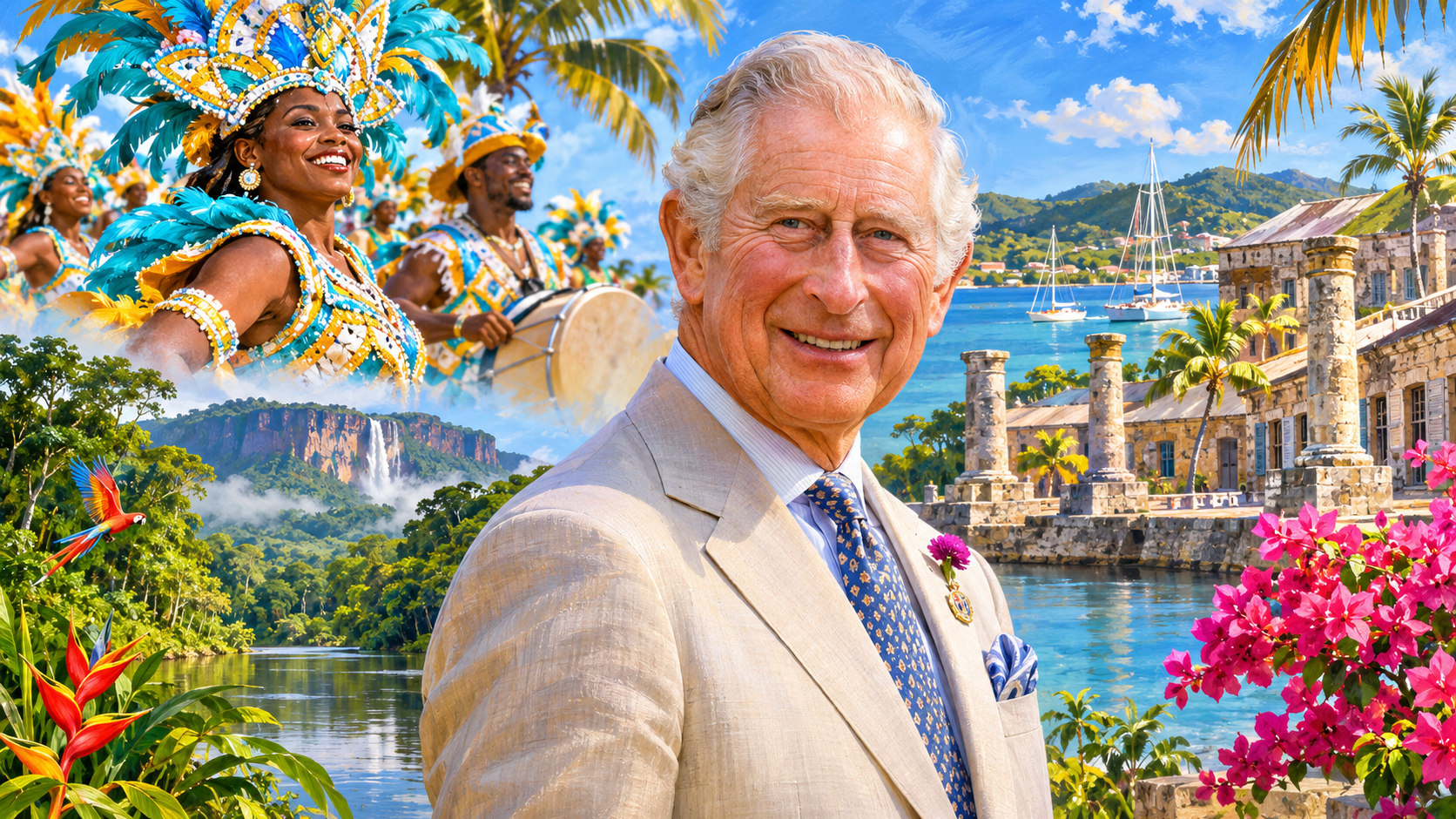
From the colourful Junkanoo celebrations of The Bahamas to the rainforests of Guyana and the historic Commonwealth gathering in Antigua and Barbuda, King Charles III’s Caribbean tour was a remarkable journey through culture, tradition, diplomacy and history.
There were cheering crowds, royal ceremonies, extraordinary natural beauty and even a tropical downpour that briefly stole the headlines. But beneath the pageantry lay a more profound question: could a King who speaks so passionately about reconciliation, conservation and the Commonwealth help bridge the painful divide between Britain’s colonial past and the Caribbean’s independent future?
It was a tour that celebrated the region’s achievements while confronting unfinished business from centuries of history.
THE BAHAMAS — A KING, A CULTURE AND THE SOUND OF JUNKANOO
The journey began in Nassau on 27 October. King Charles was welcomed by a guard of honour drawn from the Royal Bahamas Police Force and Royal Bahamas Defence Force before turning his attention to a generation that will shape the country’s future.
At Clifford Park, where The Bahamas celebrated independence in 1973, the Future Bahamas Youth Rally offered a fitting bridge between past and present. Charles had attended the independence celebrations as Prince of Wales more than half a century earlier. Now he returned as the country’s King, to performances by young choirs, spoken-word artists and musicians playing traditional rake-and-scrape.
The familiar sounds of Bahamian celebration continued in Nassau, where Junkanoo performers transformed the streets into a blaze of colour and rhythm. Yet the visit was not simply about spectacle. A conservation engagement at Bonefish Pond and meetings with local communities linked the King’s longstanding environmental interests to the everyday challenges of a nation surrounded by ocean.
The Bahamas remains an independent constitutional monarchy with Charles as head of state. The enthusiasm visible in public ceremonies therefore sits alongside a legitimate national debate about what the monarchy means to future generations. Both belong in an honest account of the visit.
GUYANA — WHERE THE ROYAL MESSAGE TURNED GREEN
On 29 October, Charles travelled to Guyana, a republic whose relationship with Britain is diplomatic rather than constitutional. President Mohamed Irfaan Ali welcomed him to Georgetown at the beginning of a two-day state visit marking 60 years of bilateral relations.
Here the emphasis shifted from pageantry to biodiversity and the people protecting it. At the Umana Yana, the King met representatives of the National Toshaos Council and received a traditional Indigenous necklace. Their discussions focused on cultural heritage and the stewardship of Guyana’s forests, which are central to the country’s identity and its environmental future.
At the Kingston Seawall, Charles heard how mangrove restoration can defend vulnerable coastlines against erosion and flooding while supporting fisheries and coastal communities. Environmental discussions linked to the Global Biodiversity Alliance and Iwokrama reinforced the idea that the Caribbean and the Guianas are not merely places endangered by climate change: they are also sources of knowledge and practical solutions.
The wider visit included meetings with business representatives and community leaders. In one of the fastest-changing economies in the region, the challenge is to ensure that opportunity, conservation and social inclusion advance together.
ANTIGUA AND BARBUDA — INDEPENDENCE, THE QUEEN AND A TROPICAL SURPRISE
The tour’s final chapter unfolded in Antigua and Barbuda, where Queen Camilla joined the King and the nation celebrated 45 years of independence on 1 November. The King and Queen attended ceremonies and engagements that placed Antiguan and Barbudan culture, young people and national pride in the foreground.
At the ceremonial parade at Sir Vivian Richards Stadium, the Caribbean weather supplied an unscripted royal moment. A sudden downpour left Charles searching for an umbrella while Camilla was ushered into shelter. The brief spectacle was widely reported and later became the subject of the King’s own humour. The rain was fleeting; the independence celebrations continued.
Beyond the lighter moment, engagements highlighting marine conservation, heritage and the historic Nelson’s Dockyard pointed to a larger argument: the country’s natural and cultural assets are not only beautiful; they are essential to jobs, tourism and long-term resilience.
THE SPEECH THAT DEFINED THE TOUR
The most consequential words came on 3 November at the opening of the Commonwealth Heads of Government Meeting in St John’s. Before representatives of the Commonwealth’s 56 member nations, the King confronted the legacy of the transatlantic trade in enslaved people and acknowledged that its effects endure.
“We cannot change the actions of those who came before us. We can, however, learn from the past.”
Charles described that history as shameful and spoke of profound personal sorrow. He also argued for action through education, jobs, greater Commonwealth trade and climate resilience. His remarks were significant, but they were not a formal apology, nor did they constitute an offer of reparations.
That distinction matters deeply in the Caribbean. Advocates for reparatory justice argue that expressions of sorrow, however sincere, cannot replace acknowledgement of responsibility and tangible repair. Others believe practical investment and renewed partnerships may offer a constructive path forward. The King’s address brought these competing expectations into the same room without resolving them.
UK Prime Minister Andy Burnham had signalled an openness to discussions about a possible formal apology while ruling out financial reparations. The Crown and the British Government have different constitutional responsibilities, making it especially important not to mistake the monarch’s words for a change in government policy.
THE COMMONWEALTH — FROM CEREMONY TO COMMITMENTS
The summit was not solely about history. Antigua and Barbuda hosted leaders, businesses and civil society under the theme ‘Accelerating Partnerships and Investment for a Prosperous Commonwealth’. The Commonwealth Secretariat reported approximately US$500 million in new commitments across initiatives including renewable energy, young people’s skills and trade. These are commitments spanning the wider Commonwealth, not a Caribbean reparations settlement.
For Caribbean governments, the most meaningful test will be implementation: more accessible finance after storms, protection for coastal settlements, sustainable investment, stronger intra-Commonwealth trade and opportunities for their young people. The region needs dependable partnerships as much as it needs sympathetic speeches.
THE CARIBBEAN WORLD VERDICT — THE REGION HAS THE FINAL WORD
The King travelled as head of state in The Bahamas and Antigua and Barbuda, and as a visiting foreign monarch in republican Guyana. That contrast captured the modern Caribbean better than any ceremonial photograph could. Some countries have retained constitutional ties to the Crown; others, including Guyana and Barbados, have chosen republican paths. Their different choices deserve equal respect.
The strongest memories of this tour will be the young performers in Nassau, Indigenous voices in Georgetown, the rain-soaked independence parade in Antigua and the sober words delivered at the Commonwealth summit. Together, they tell a story of a Caribbean confident enough to celebrate its culture and determined enough to ask difficult questions of history.
Can the Crown heal the wounds of slavery? A nine-day tour cannot do that. But respectful listening, truthful acknowledgement and measurable partnership can help shape what happens next. The decisive voice, as ever, belongs to the people of the Caribbean.