
By Publisher Ray Carmen
Deep in the tropical landscape of Cambodia stands a monument so vast, so beautiful and so ambitious that it continues to astonish the world nearly nine centuries after it was built.
This is Angkor Wat—the largest religious monument on Earth and one of humanity’s greatest architectural achievements.
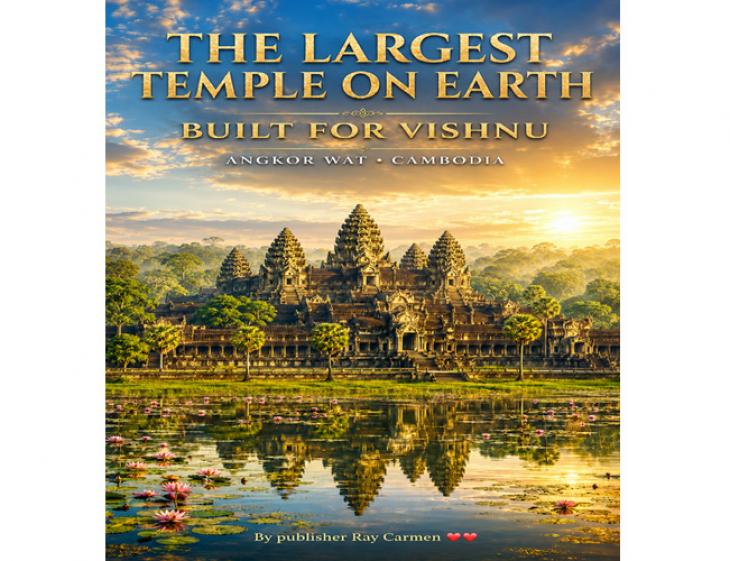
Surrounded by forests, ancient waterways and the remains of the mighty Khmer Empire, Angkor Wat rises from the Cambodian landscape like a vision from another age. Its famous towers reach towards the sky while their reflections shimmer in the great moat below.
The scale of the temple is almost beyond belief.
The entire complex covers approximately 162 hectares—more than three times the area of Vatican City. Its enormous moat, long galleries, ceremonial courtyards and soaring towers form a sacred landscape designed to represent the Hindu universe itself.
Angkor Wat was not simply constructed as a place of worship. It was created as a symbol of divine order, royal authority and the extraordinary power of the Khmer Empire.
BUILT BY KING SURYAVARMAN II
Angkor Wat was built during the first half of the 12th century under King Suryavarman II, one of the most powerful rulers of the Khmer Empire.
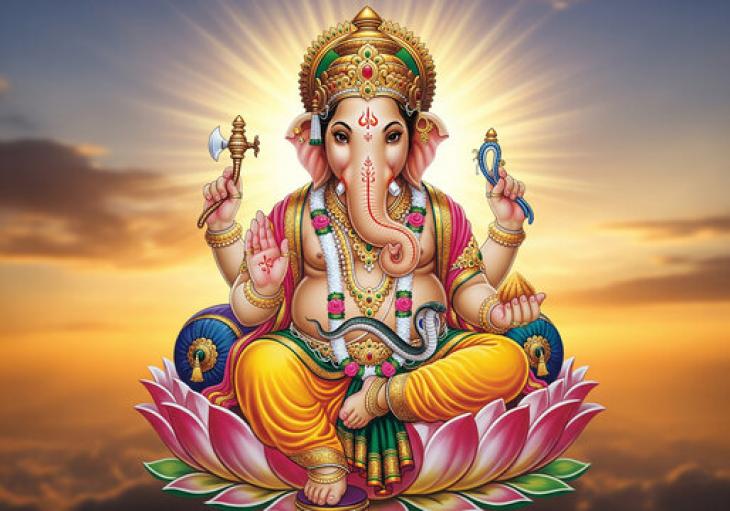
The king dedicated this monumental temple to Lord Vishnu, the Hindu deity associated with preservation, protection and cosmic order.
Most major Khmer temples were traditionally dedicated to Shiva, making Suryavarman II’s devotion to Vishnu particularly significant. Angkor Wat was therefore designed not only as a royal temple but also as a magnificent earthly home for the divine presence of Lord Vishnu.
Its original name is believed to have been “Vrah Vishnuloka,” meaning the Sacred Dwelling of Vishnu.
The construction of such an immense complex required remarkable planning, engineering and human effort. Vast quantities of sandstone were quarried, transported and fitted together with astonishing precision. Thousands of labourers, engineers, stonecutters, sculptors and artisans would have contributed to its creation.
Even today, the achievement remains breathtaking.
A TEMPLE DESIGNED AS THE HINDU UNIVERSE
Every major part of Angkor Wat carries spiritual meaning.
The five central towers represent the five peaks of Mount Meru—the sacred mountain believed in Hindu tradition to stand at the centre of the universe and to serve as the dwelling place of the gods.
The surrounding galleries represent mountain ranges, while the enormous moat symbolises the cosmic ocean encircling the world.
Visitors approaching the temple cross a long stone causeway over the water. With every step, the towers appear to rise higher and become more imposing. The journey towards the centre of Angkor Wat was designed to feel like a spiritual ascent—from the human world towards the divine.
Unlike most Khmer temples, Angkor Wat faces west. The reason for this unusual orientation continues to inspire discussion. Some scholars connect it with Lord Vishnu, who is traditionally associated with the west. Others believe the orientation may also reflect the temple’s possible role as a royal funerary monument for Suryavarman II.
Whatever its full purpose, the design of Angkor Wat was deliberate, symbolic and deeply sacred.
WALLS THAT TELL EPIC STORIES
The long stone galleries of Angkor Wat contain some of the most magnificent bas-reliefs ever created.
Across the walls, ancient sculptors carved great scenes from Hindu mythology and Khmer history. These include episodes from the Ramayana and the Mahabharata, royal processions, heavenly beings, warriors, animals and scenes of judgement in the afterlife.
One of the most celebrated carvings depicts the Churning of the Ocean of Milk.
In this famous Hindu story, gods and demons work together to churn the cosmic ocean in search of amrita—the nectar of immortality. Using the great serpent Vasuki as a rope, they pull back and forth around Mount Mandara until divine treasures emerge from the ocean.
The scene stretches dramatically across the gallery wall, filled with movement, symbolism and extraordinary detail.
Thousands of celestial dancers known as apsaras also appear throughout the temple. Each figure is delicately carved, with distinctive jewellery, hairstyles, clothing and expressions. Together they give Angkor Wat an atmosphere of grace, beauty and divine celebration.
FROM HINDU TEMPLE TO BUDDHIST SANCTUARY
Although Angkor Wat was originally dedicated to Lord Vishnu, its spiritual story did not end with the decline of the Khmer Empire.
Over the centuries, the temple gradually became an important centre of Buddhist worship. Unlike many other ancient monuments that were completely abandoned, Angkor Wat remained an active sacred place.
Hindu and Buddhist traditions now form different layers of its remarkable history.
This continuity helped preserve the temple through centuries of political change, conflict and environmental challenges. Monks, worshippers, local communities, conservators and archaeologists have all played a part in keeping its sacred legacy alive.
Today, Angkor Wat remains a place of devotion as well as one of the world’s most recognisable historical landmarks.