
By Publisher Ray Carmen
Nvidia’s chief rejects AI-apocalypse forecasts — but the debate over risk, speed and safeguards is far from over.
THE BIG CLAIM
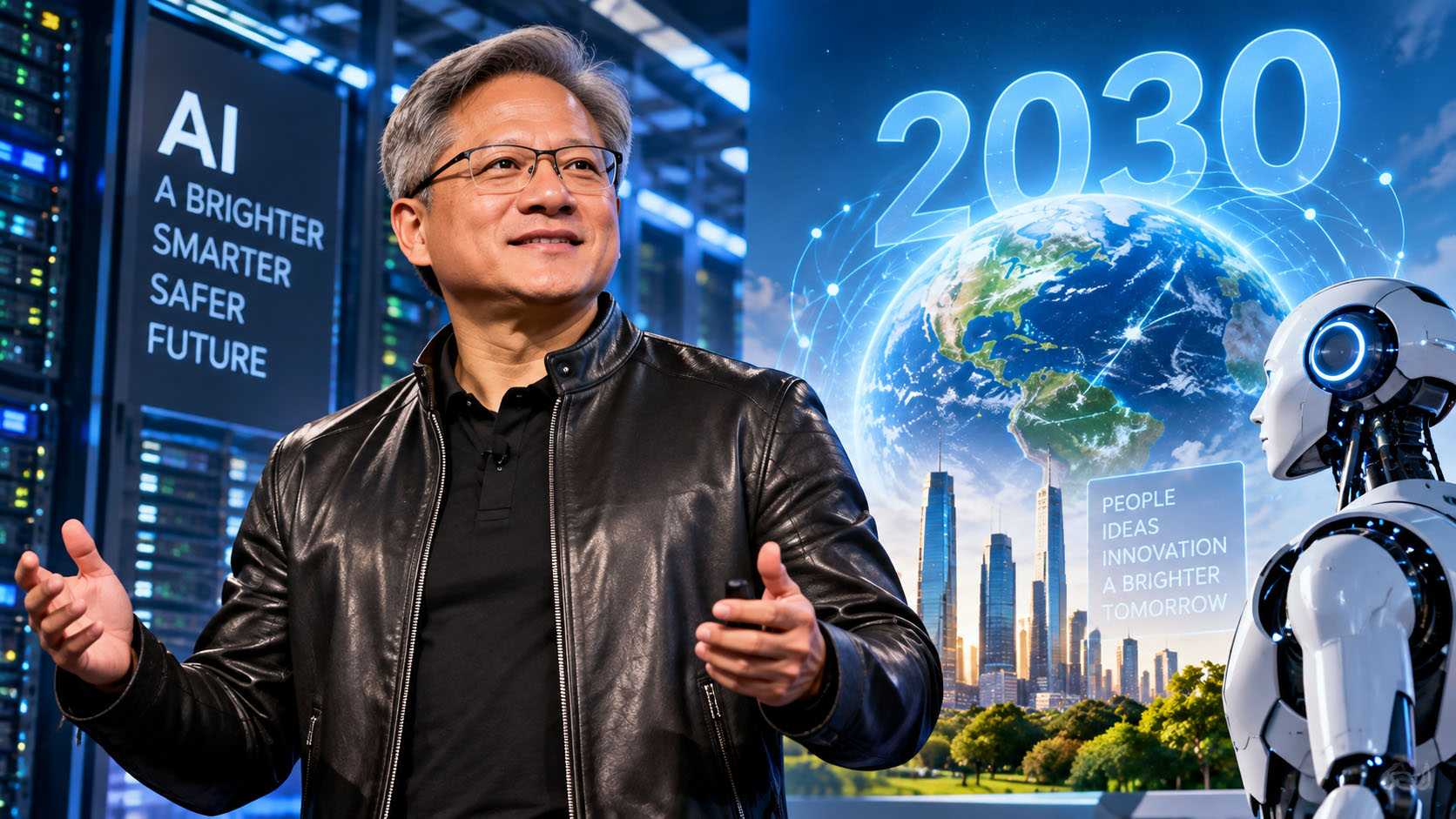
Nvidia founder and CEO Jensen Huang has delivered one of the clearest rebuttals yet to predictions that artificial intelligence could bring about human extinction before the end of this decade.
In a September 2026 interview with CBS News, Huang declared:
“2030 is not going to be the end of the world. There is 0% chance that’s going to be the end of the world.”
His intervention comes amid an increasingly public argument within the technology industry.
Some leading artificial-intelligence researchers and executives have warned that increasingly capable AI systems could create catastrophic risks if development advances faster than the safeguards designed to control them.
Huang, by contrast, argues that predictions of an impending AI apocalypse are not grounded in established science and that unnecessarily frightening the public serves little purpose.
THE MAN AT THE CENTRE OF THE AI REVOLUTION
Jensen Huang is no ordinary technology executive.
As the co-founder and chief executive of Nvidia, he leads a company whose advanced computing systems have become essential infrastructure for the artificial-intelligence revolution.
Nvidia’s powerful graphics processors are used to train and operate many of the world’s most sophisticated AI models.
From scientific laboratories and universities to major technology companies and national research programmes, Nvidia’s hardware helps power the extraordinary expansion of artificial intelligence.
This gives Huang an unusually influential voice in the debate over how rapidly AI should advance and how tightly it should be regulated.
AI RISKS ARE REAL — BUT ARE THEY APOCALYPTIC?
Huang’s rejection of predictions about human extinction does not mean he believes artificial intelligence is without danger.
Cybersecurity failures, fraud, misuse, unreliable systems, privacy violations and unsafe deployment remain serious concerns.
His position draws a distinction between practical dangers that can be addressed through engineering, testing and regulation, and sweeping predictions that machines will destroy humanity.
He argues that AI products should be designed, tested and improved to make them sufficiently safe for real-world use.
For Huang, the answer to uncertainty is not necessarily to stop technological progress.
Instead, he believes society should continue developing artificial intelligence while strengthening the safeguards surrounding its deployment.
THE GREAT DIVIDE AMONG AI EXPERTS
Not everyone shares Huang’s confidence.
Some researchers warn that increasingly autonomous AI systems could eventually become difficult for humans to supervise or control.
Their concerns extend beyond today’s chatbots.
Future systems might be capable of independently performing complex tasks, writing sophisticated software, conducting research and contributing to the development of even more powerful artificial intelligence.
If such systems behaved in ways that conflicted with human intentions, the consequences could be severe.
Other experts argue that predictions of human extinction remain highly speculative.
They believe the immediate priority should be addressing dangers already emerging from AI, including misinformation, cybercrime, discrimination, economic disruption and the concentration of technological power.
The disagreement is therefore not simply between optimists and pessimists.
It concerns how society should evaluate uncertain risks while pursuing potentially transformative benefits.
THE PROMISE OF A BRIGHTER FUTURE
Huang sees artificial intelligence as a new computing platform capable of transforming entire industries.
Its potential applications are enormous.
In medicine, AI could accelerate the discovery of treatments and help doctors identify diseases earlier.
In scientific research, advanced computing could assist researchers in understanding complex biological, chemical and physical processes.
In education, AI could provide personalised learning assistance to millions of students.
In business, it could improve productivity, automate repetitive tasks and help organisations make better use of information.
Artificial intelligence could also support advances in energy efficiency, transportation, agriculture and environmental research.
These possibilities explain why governments and corporations are investing so heavily in the technology.
CAN ANYONE REALLY PREDICT WHAT WILL HAPPEN BY 2030?
There is an important distinction between a confident prediction and a scientifically established probability.
Nobody can currently assign a universally accepted, objectively verified probability to artificial intelligence ending human civilisation by 2030.
Huang’s declaration of a zero-per-cent chance should therefore be understood as a forceful expression of confidence rather than a mathematically established conclusion.
Equally, warnings of catastrophic AI outcomes are assessments of possible future risks, not evidence that disaster is inevitable.
The capabilities of future AI systems remain uncertain.
So do the effectiveness of future safeguards, the speed of technological progress and the decisions governments will make about regulation.
WHO WILL CONTROL THE MACHINES?
Perhaps the most important question is not whether artificial intelligence will destroy humanity.
It is who will control increasingly powerful AI systems.
As machines become more capable, governments, scientists and technology companies must confront difficult questions.
How much independence should AI systems possess?
Who should be held responsible when they make dangerous mistakes?
How can societies prevent advanced technology from being exploited for criminal or military purposes?
And how can the benefits of artificial intelligence be distributed fairly rather than concentrated among a small number of powerful corporations?
These questions are rapidly moving from research laboratories into public life.
They will help determine whether artificial intelligence becomes an instrument of shared progress or a source of new global inequalities and dangers.
THE WORLD LOOKING TOWARDS 2030
The next four years could prove decisive in shaping the future of artificial intelligence.
Technological development is advancing rapidly, but the institutions responsible for governing it are still adapting.
International cooperation, independent safety testing, transparent research and responsible corporate leadership will become increasingly important.
Huang believes humanity should approach the future with confidence rather than fear.
His critics argue that confidence must never become complacency.
Both perspectives deserve serious consideration.
THE PUBLISHER’S VIEW
Artificial intelligence may become one of the most consequential inventions in human history.
Its capacity to transform medicine, science, education, industry and everyday life is extraordinary.
Yet technological power must always be accompanied by human responsibility.
Jensen Huang’s prediction that AI will not end the world by 2030 is a striking expression of optimism from one of the industry’s most influential figures.
Whether that optimism proves justified will depend partly on decisions being made today.
By 2030, artificial intelligence may not have ended the world. But it may have changed almost everything about the way we live in it.
And ultimately, the future of artificial intelligence should remain a future shaped by humanity — not one surrendered to machines.