

A BOLD VISION OF TOMORROW’S OCEAN CITIES
By Publisher Ray Carmen
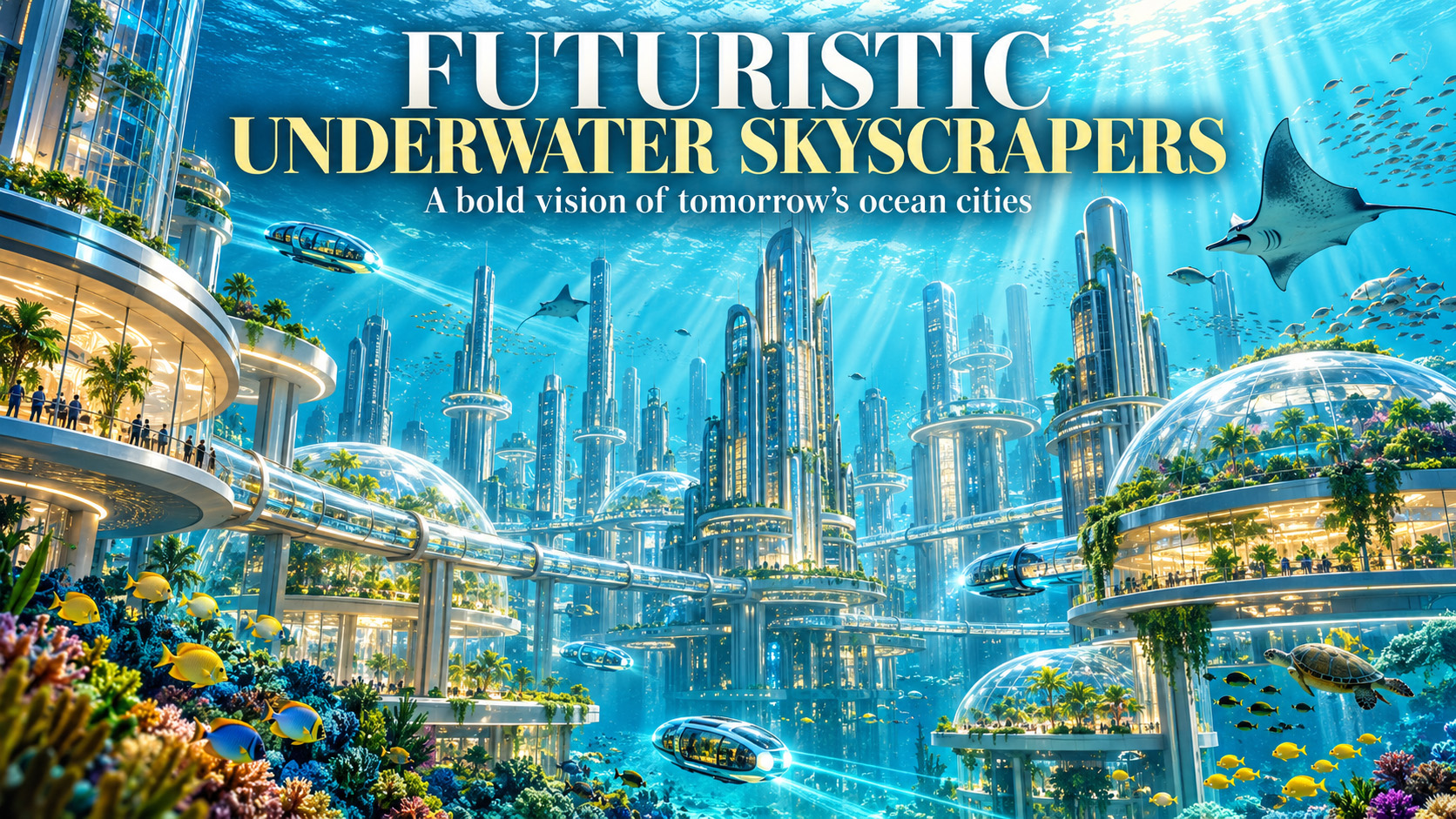
Imagine waking up in a magnificent glass skyscraper hundreds of feet beneath the ocean, watching tropical fish swim past your bedroom window while futuristic submarines glide silently between underwater towers.
Science fiction? Perhaps today. But could this extraordinary vision become part of humanity’s future?
THE NEXT FRONTIER OF HUMAN CIVILISATION
For centuries, mankind has looked towards the skies, building ever-taller skyscrapers and dreaming of establishing cities on distant planets.
But what if the next great architectural revolution takes place not above the clouds, but beneath the waves?
Imagine entire communities living underwater.
Magnificent residential towers surrounded by marine life. Glass-domed botanical gardens filled with tropical vegetation. Luxury hotels overlooking coral reefs. Restaurants where diners watch rays and colourful fish swim past panoramic windows.
Futuristic transport capsules could connect buildings through enclosed tunnels, while advanced engineering systems provide electricity, fresh water and breathable air.
It is a breathtaking vision.
And although underwater skyscraper cities of this scale do not currently exist, architects, scientists and engineers have already begun exploring technologies that could make more ambitious underwater living possible.
1. THE UNDERWATER CITY OF TOMORROW
The concept of underwater living is not entirely new.
For decades, scientists have operated specialised underwater habitats to study marine environments.
However, the idea of transforming these relatively small research facilities into permanent cities represents an entirely different challenge.
A future underwater metropolis might include residential apartments, scientific laboratories, hospitals, schools, entertainment centres and commercial districts.
Enormous transparent observation windows could offer residents spectacular views of the surrounding ocean.
Rather than conventional streets, enclosed pedestrian corridors and automated transport systems might connect different sections of the development.
At its most ambitious, such a city could become a remarkable combination of architecture, marine engineering and advanced environmental technology.
But creating this vision would require major breakthroughs in construction, safety and affordability.
2. JAPAN’S EXTRAORDINARY OCEAN SPIRAL PROJECT
One of the most fascinating proposals for underwater urban development comes from Japan.
Japanese construction company Shimizu Corporation unveiled an ambitious concept known as Ocean Spiral.
The proposed development features an enormous spherical structure approximately 500 metres in diameter.
Its designers envisaged accommodation for around 5,000 people, together with residential, commercial and research facilities.
A vast spiral structure would connect the inhabited sphere with installations deep beneath the ocean.
The concept also explores generating energy from differences in ocean temperatures and producing fresh water through desalination.
Ocean Spiral remains a visionary proposal rather than a completed underwater city.
Nevertheless, it demonstrates the extraordinary ambition of architects and engineers who believe humanity’s relationship with the oceans could change dramatically.
3. LUXURY LIVING BENEATH THE WAVES
Imagine owning an exclusive underwater apartment.
Instead of overlooking London’s skyline, New York’s Central Park or Dubai’s spectacular waterfront, your living room would face a magnificent underwater landscape.
Floor-to-ceiling observation windows might reveal colourful fish, rays and other marine creatures.
Private suites could feature sophisticated lighting, elegant interiors and panoramic ocean views.
Luxury underwater hotels already demonstrate a limited version of this experience, offering specially engineered submerged accommodation.
But transforming isolated luxury suites into entire residential skyscrapers would be vastly more complicated.
Future underwater property development would need to address structural integrity, emergency evacuation, maintenance and long-term operating costs.
Even so, the concept could eventually create an entirely new category of luxury real estate.
The ultimate waterfront property might one day be beneath the waterfront itself.
4. UNDERWATER TRANSPORT — A NEW WAY TO TRAVEL
How would residents travel between underwater buildings?
One possibility involves sealed tunnels connecting different structures.
Automated electric vehicles could transport passengers through these corridors.
Specialised submersibles might provide additional connections between research stations, tourism facilities and underwater transport terminals.
Imagine boarding a transparent observation capsule and travelling through the ocean while marine life moves around you.
Such systems would require exceptionally reliable navigation, pressure-resistant construction and emergency procedures.
The technology would be challenging, but the possibilities are fascinating.
5. THE ENGINEERING CHALLENGE
The greatest obstacle to constructing underwater skyscrapers is the extraordinary pressure exerted by the ocean.
Water pressure increases by approximately one atmosphere for every ten metres of depth.
At 100 metres beneath the surface, a structure must withstand an external pressure of roughly eleven atmospheres in total.
At greater depths, the engineering challenges become increasingly severe.
Materials would need to resist corrosion, fatigue and immense mechanical forces.
Buildings would require dependable life-support systems, fire protection, emergency exits and backup energy supplies.
Even ordinary maintenance could become a highly specialised operation.
The deeper the development, the more complicated and expensive these challenges would become.
Consequently, the first substantial underwater residential communities, if they are eventually constructed, would probably favour relatively shallow and carefully selected locations.
6. CAN UNDERWATER CITIES BE SELF-SUFFICIENT?
A permanent underwater settlement would require dependable supplies of energy, drinking water, food and oxygen.
Engineers have explored several possibilities.
Ocean thermal energy conversion could potentially generate electricity by exploiting temperature differences between warm surface water and colder deep water.
Desalination systems could produce drinking water.
Hydroponic agriculture might provide some fresh produce inside controlled growing environments.
Advanced recycling systems could reduce waste and recover valuable resources.
However, genuine self-sufficiency would be difficult to achieve.
Large settlements would still require extensive maintenance, replacement equipment, medical supplies and reliable connections with the surface.
The dream of an entirely independent underwater civilisation therefore remains a distant ambition.
7. A PARADISE FOR MARINE SCIENCE
Perhaps the strongest argument for developing underwater habitats is scientific research.
Permanent marine laboratories could allow researchers to observe underwater ecosystems for extended periods.
Scientists might study coral reef restoration, marine biodiversity, ocean chemistry and the effects of climate change.
Advanced underwater monitoring stations could provide valuable information about changing ocean conditions.
Such facilities could also support new developments in robotics, environmental sensors and marine engineering.
The oceans remain among Earth’s least accessible environments.
Better research infrastructure could transform our understanding of them.
8. PROTECTING THE UNDERWATER WORLD
There is, however, an important environmental question.
Should humanity build enormous cities in fragile marine environments?
Construction could damage seabed habitats, disturb marine species and introduce noise, artificial lighting and pollution.
Even carefully designed developments could alter local ecosystems.
Coral reefs, in particular, require protection rather than additional disturbance.
Any serious underwater development would therefore need comprehensive environmental assessments, strict regulation and long-term ecological monitoring.
Future ocean architecture must not sacrifice marine biodiversity in the pursuit of technological ambition.
The greatest underwater city would be one that respects the ocean rather than conquers it.
9. COULD UNDERWATER CITIES HELP WITH CLIMATE CHANGE?
Rising sea levels and coastal flooding have encouraged architects to explore alternative forms of development.
Floating neighbourhoods, flood-resistant buildings and adaptable coastal infrastructure are already important areas of research.
Underwater cities are sometimes proposed as another possible response.
However, living beneath the ocean would not automatically solve the problems caused by rising seas.
Underwater structures would face significant engineering, environmental and evacuation challenges.
For most coastal communities, conventional flood protection, resilient infrastructure and carefully planned adaptation would remain more practical solutions.
Nevertheless, underwater engineering research could contribute valuable technologies to future coastal development.
10. THE WORLD IN 2126 — A CENTURY FROM NOW
Imagine the year 2126.
Humanity has developed extraordinary new construction materials, sophisticated marine robotics and advanced energy systems.
Perhaps small underwater communities have evolved into permanent scientific settlements.
Perhaps luxury underwater hotels have become established attractions in carefully managed marine locations.
And perhaps architects have begun constructing the first genuinely substantial underwater residential complexes.
Visitors might descend through transparent transport tunnels to reach beautifully illuminated buildings surrounded by marine life.
Scientists could work in advanced laboratories while families enjoy extraordinary views of the underwater world.
It would be a remarkable achievement.
Yet whether such cities become economically practical, environmentally acceptable and safe enough for widespread habitation remains uncertain.
For now, the underwater skyscrapers depicted in futuristic illustrations belong to the world of architectural imagination.
But imagination has always played an important role in technological progress.
THE FINAL FRONTIER MAY BE BENEATH OUR FEET
The twentieth century transformed the world’s skylines.
The twenty-first century is witnessing extraordinary advances in artificial intelligence, robotics, materials science and marine exploration.
Could the twenty-second century bring a new era of underwater architecture?
Perhaps.
What is certain is that humanity’s fascination with the oceans will continue.
The sea represents mystery, beauty, scientific opportunity and extraordinary engineering challenges.
And somewhere between today’s underwater research laboratories and tomorrow’s architectural dreams lies the possibility of a very different relationship with our planet.
WE HAVE BUILT CITIES THAT REACH FOR THE STARS.
ONE DAY, WE MAY BUILD CITIES THAT LOOK OUT INTO THE DEEP BLUE SEA.