
MUSIC LEGENDS — A WORLD OF 7 & CARIBBEAN WORLD MAGAZINE SPECIAL FEATURE
By Publisher Ray Carmen
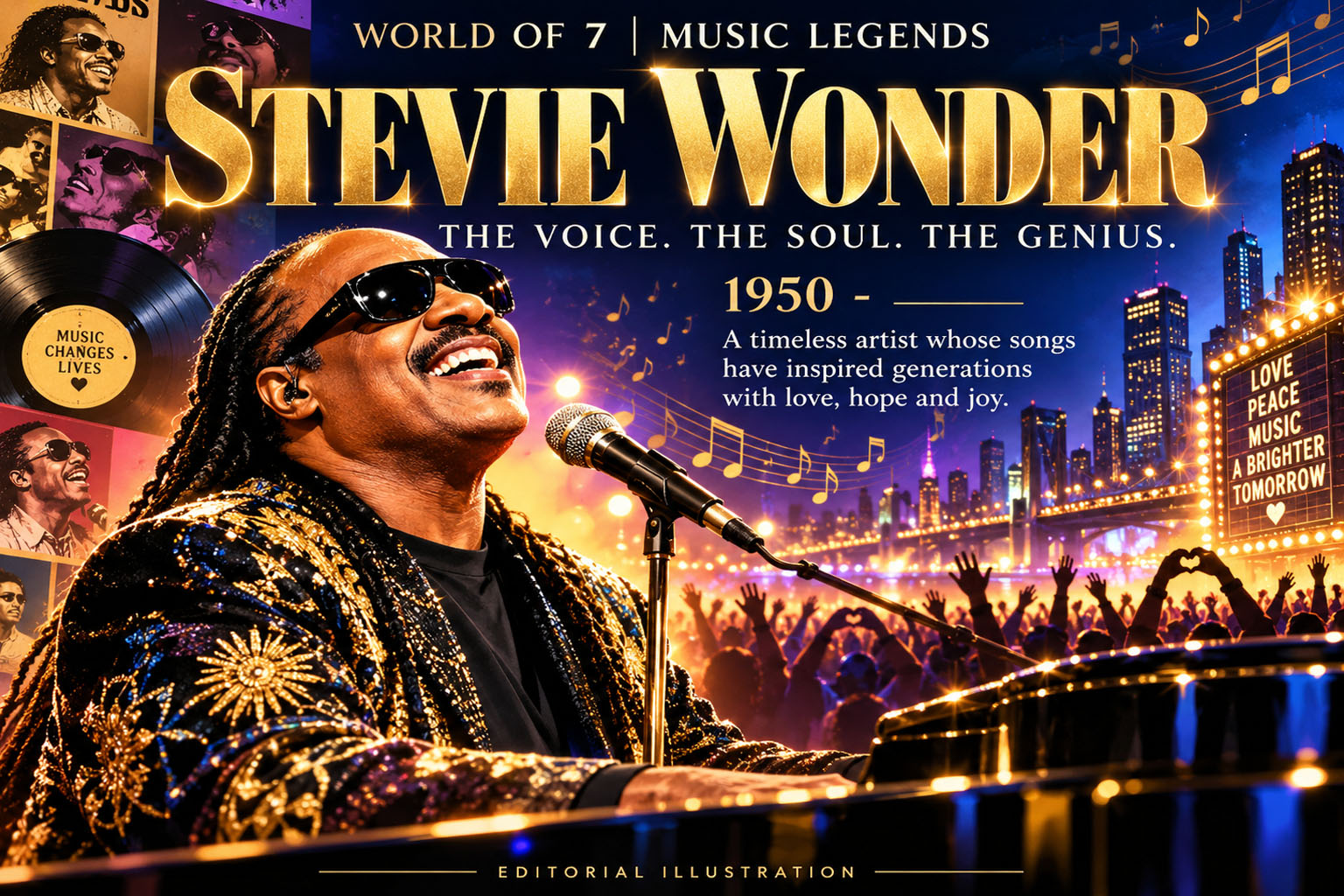
From a blind child prodigy in Detroit to one of the most celebrated musicians in history, Stevie Wonder has given the world something that transcends generations, nationalities and cultures: music that touches the human soul.
THE MAN WHO MADE THE WORLD SING
Some artists create hit records. Others change the very sound of popular music.
Stevie Wonder has spent a lifetime doing both.
There are voices we recognise instantly, melodies that transport us back through the years, and songs that become inseparable from the memories of our lives.
For millions of people around the world, Stevie Wonder represents all three.
Think of the irresistible rhythm of Superstition, the tenderness of You Are the Sunshine of My Life, the infectious happiness of Sir Duke, or the beautiful simplicity of I Just Called to Say I Love You.
These are not merely successful recordings.
They are part of the soundtrack of humanity.
At 76, Stevie Wonder remains one of the most influential musicians of modern times — a singer, songwriter, composer, producer and instrumentalist whose achievements have transformed popular music.
But his greatest accomplishment may be something far more profound.
He has used music to bring people together.
FROM LITTLE STEVIE TO INTERNATIONAL STARDOM
Born Stevland Hardaway Morris on 13 May 1950 in Saginaw, Michigan, Stevie Wonder became blind shortly after birth.
Growing up in Detroit, he demonstrated extraordinary musical ability.
He learned to play the piano, harmonica and drums, developing a natural understanding of rhythm and melody that would eventually astonish the world.
At just eleven years old, he signed with Motown’s Tamla label.
The young musician became known as Little Stevie Wonder.
In 1963, aged thirteen, he achieved his first American number-one hit with the live recording Fingertips (Part 2).
A remarkable career had begun.
But even Motown could scarcely have imagined the musical revolution that lay ahead.
THE GOLDEN YEARS OF MUSICAL GENIUS
The 1970s became Stevie Wonder’s extraordinary creative decade.
Having secured greater artistic independence, he embarked upon a sequence of albums that would redefine soul, funk, rhythm and blues, and contemporary popular music.
Music of My Mind and Talking Book appeared in 1972.
Innervisions followed in 1973.
Fulfillingness’ First Finale arrived in 1974.
Then, in 1976, came the magnificent Songs in the Key of Life.
This extraordinary album brought together love, family, childhood memories, social awareness and musical celebration.
Songs including Isn’t She Lovely, I Wish, As and Sir Duke demonstrated Wonder’s remarkable ability to combine musical sophistication with universal emotional appeal.
His arrangements were innovative.
His melodies were unforgettable.
His voice was unmistakable.
And his music crossed boundaries that had previously divided audiences.
THE SONGS THAT CAPTURED THE WORLD
What makes Stevie Wonder so extraordinary is not simply his musical brilliance.
It is his ability to express emotions that belong to everyone.
Isn’t She Lovely celebrates the joy of welcoming a daughter into the world.
You Are the Sunshine of My Life captures the tenderness of romantic devotion.
Signed, Sealed, Delivered I’m Yours bursts with happiness and confidence.
Superstition remains one of the most recognisable recordings in the history of funk.
And Living for the City confronts racial injustice and inequality through powerful musical storytelling.
Then came another international favourite.
In 1984, Wonder recorded I Just Called to Say I Love You for the film The Woman in Red.
The song won the Academy Award for Best Original Song and became an enduring favourite across continents.
Its message was wonderfully simple.
Love needs no special occasion.
A VOICE FOR HUMANITY
Stevie Wonder’s contribution extends far beyond the recording studio.
Throughout his career, he has championed civil rights, racial equality, disability rights and humanitarian causes.
One of his most important contributions was his campaign to establish a United States federal holiday honouring Dr Martin Luther King Jr.
His 1980 recording Happy Birthday became closely associated with the campaign.
Congress approved the holiday in 1983, and it was first observed federally in 1986.
Wonder also participated in the historic 1985 charity recording We Are the World, which brought together some of the greatest names in international music to support humanitarian relief efforts in Africa.
His involvement in campaigns against apartheid and his advocacy for peace reinforced his reputation as an artist with a powerful social conscience.
For Stevie Wonder, music has never been simply entertainment.
It has also been a means of encouraging understanding, compassion and change.
A SPECIAL CONNECTION WITH THE CARIBBEAN
Although Stevie Wonder’s musical roots lie in Detroit and the traditions of American soul, his influence extends throughout the Caribbean.
His music has long been embraced by audiences who appreciate the expressive rhythms of reggae, calypso, soca, soul and rhythm and blues.
Caribbean musicians and entertainers have drawn inspiration from the musical freedom, emotional depth and rhythmic imagination that characterise his recordings.
His songs are familiar at celebrations, weddings, concerts and social gatherings throughout the region.
The connection is not one of birthplace or nationality.
It is the shared international language of music.
That makes Stevie Wonder a natural subject for both Caribbean World Magazine and WORLD OF 7.
THE HONOURS OF AN EXTRAORDINARY CAREER
Stevie Wonder’s achievements are remarkable.
He has received 25 Grammy Awards, together with a Grammy Lifetime Achievement Award.
He was inducted into the Rock & Roll Hall of Fame in 1989.
He received a Kennedy Center Honor in 1999.
In 2009, he was awarded the Library of Congress Gershwin Prize for Popular Song.
He was also named a United Nations Messenger of Peace.
His influence reaches far beyond the honours themselves.
Generations of musicians have studied his compositions, admired his arrangements and drawn inspiration from his ability to unite different musical traditions.
Yet his greatest reward may be the affection of audiences who continue to treasure his songs.
SEVEN STEVIE WONDER SONGS THE WORLD WILL NEVER FORGET
- Uptight (Everything’s Alright) — 1965
The exuberant energy of young Motown.
- Signed, Sealed, Delivered I’m Yours — 1970
An irresistible declaration of love and devotion.
- Superstition — 1972
One of the greatest and most recognisable funk recordings ever produced.
- Living for the City — 1973
A powerful musical statement about inequality and social injustice.
- Isn’t She Lovely — 1976
A father’s beautiful celebration of his newborn daughter.
- Sir Duke — 1976
A joyous tribute to Duke Ellington and the great musicians who shaped popular music.
- I Just Called to Say I Love You — 1984
A timeless international favourite celebrating the simple beauty of love.
THE WONDER WILL NEVER FADE
There are musicians whose fame belongs to a particular generation.
And there are artists whose music becomes part of the world’s cultural inheritance.
Stevie Wonder belongs firmly in the second category.
His songs have accompanied weddings, birthdays, family celebrations and moments of personal reflection.
They have filled concert halls, inspired musicians and brought joy to countless homes.
His extraordinary talent has demonstrated that music can entertain while also addressing the deepest concerns of humanity.
Love.
Equality.
Peace.
Hope.
These are the themes that have defined his career.
And they are the reasons his music continues to resonate.
For Caribbean World Magazine and WORLD OF 7, our tribute is simple.
Thank you, Stevie Wonder, for the melodies, the memories and the magnificent music.
You have given the world far more than songs.
You have given it a lifetime of wonder.
CARIBBEAN WORLD MAGAZINE
A Class of Its Own.
WORLD OF 7
ONE PLANET. 7 CONTINENTS. ONE WEEKLY GLOBAL VIEW.