
THE GREAT PLANETARY SWAP – WOULD HUMANITY SURVIVE?
By Publisher Ray Carmen
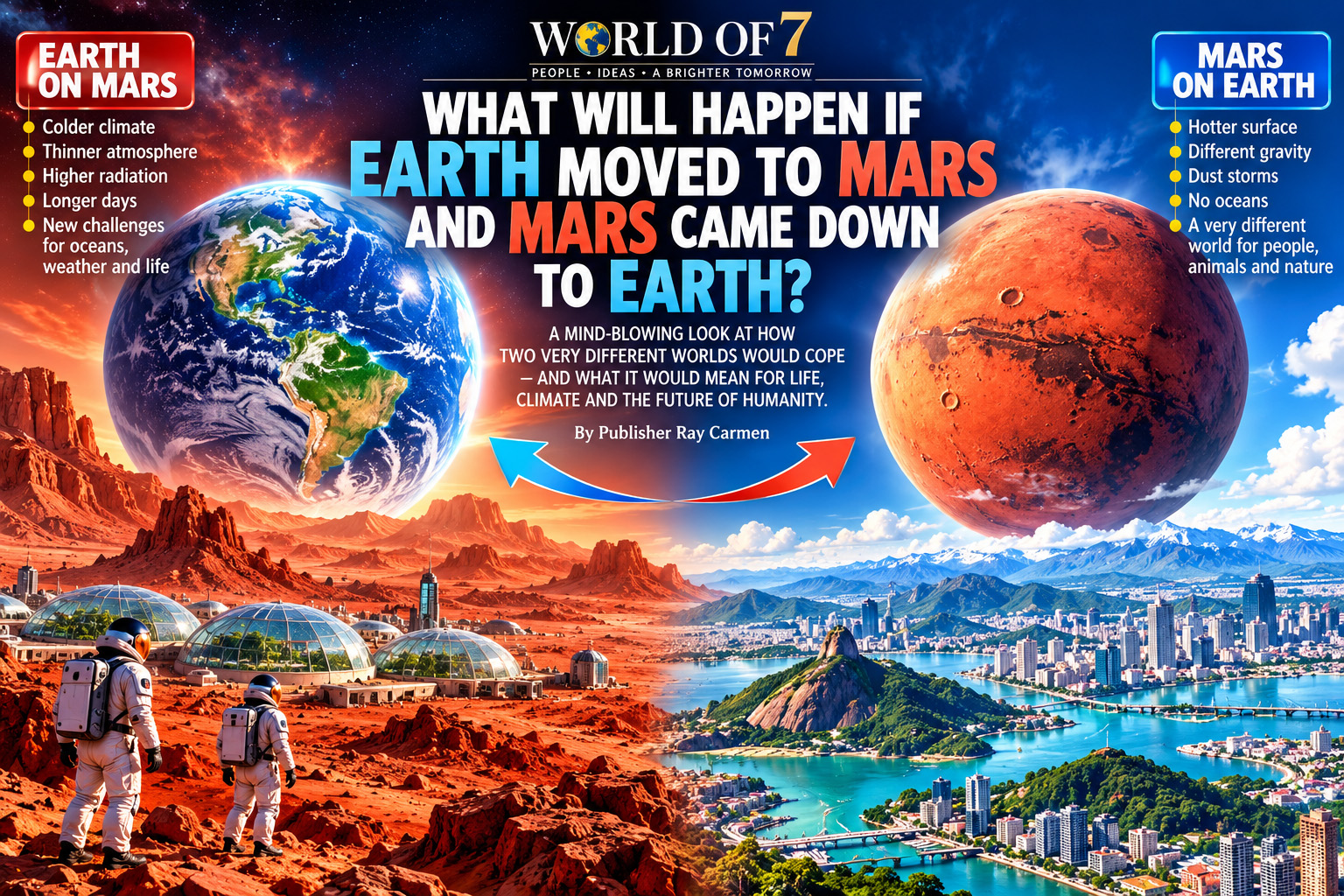
Imagine waking up tomorrow morning to discover that our beautiful blue planet Earth has exchanged places with Mars. Earth now travels around the Sun in the colder reaches of space, while the mysterious Red Planet occupies Earth’s familiar orbit.
Would our oceans freeze? Would Mars suddenly blossom with life? Could humanity survive? And what would happen to the Caribbean’s glorious sunshine, turquoise seas and tropical islands?
The answers reveal just how extraordinary our planet really is.
1. THE DAY EARTH LEAVES HOME
Earth currently orbits approximately 150 million kilometres from the Sun.
Mars travels considerably farther away, averaging around 228 million kilometres.
Now imagine a cosmic miracle in which the two planets exchange orbits without colliding with anything or disturbing the rest of the Solar System.
Earth suddenly finds itself receiving only about 43% of the sunlight it enjoys today.
That is an astonishing reduction.
The consequences would not be instantaneous. Earth’s atmosphere and oceans store enormous quantities of heat, so temperatures would fall progressively rather than plunging overnight.
Nevertheless, the direction would be unmistakable.
Our planet would begin a dramatic journey towards a much colder future.
2. WOULD EARTH BECOME A FROZEN PLANET?
Quite possibly.
As temperatures declined, polar ice would spread into regions that are currently temperate.
Snow would accumulate across vast continental areas.
Sea ice would advance across the oceans, potentially disrupting the circulation systems that distribute heat around the globe.
Eventually, Earth might enter an extreme ice-age state.
Scientists call one possible outcome Snowball Earth, a condition in which ice covers most or nearly all of the planet.
Earth has experienced episodes of extraordinary global glaciation in its distant geological past.
But an Earth permanently receiving substantially less sunlight would face an exceptionally difficult challenge.
There is another danger.
Ice reflects sunlight back into space. As more ice forms, Earth absorbs less solar energy, causing further cooling.
Scientists call this the ice-albedo feedback.
It could turn an already serious climate crisis into a self-reinforcing planetary transformation.
3. WHAT WOULD HAPPEN TO THE CARIBBEAN?
Imagine the Caribbean without its famous tropical sunshine.
The magnificent beaches of Barbados, Jamaica, Antigua, Saint Lucia and the Bahamas could experience a climate utterly unlike anything in their recorded history.
As global temperatures declined, tropical waters would gradually cool.
Coral reefs would face severe environmental disruption.
Marine ecosystems would change dramatically, and fisheries could suffer catastrophic losses.
Tourism, agriculture and coastal communities would confront unprecedented challenges.
If the planet entered a sufficiently extreme glaciation, even tropical seas could eventually become covered by ice.
The Caribbean’s celebrated turquoise waters might become part of an extraordinary frozen landscape.
Yet the islands would not freeze instantly. Their surrounding oceans would initially moderate temperature changes.
The ultimate outcome would depend on the severity and duration of global cooling.
For a region whose identity is so closely connected to sunshine, warm seas and tropical life, the transformation would be almost unimaginable.
4. WHAT WOULD HAPPEN TO HUMANITY?
Human civilisation would confront challenges unlike anything in recorded history.
Agriculture would be among the first major casualties.
Traditional growing seasons would shorten, crop yields would collapse in many regions, and food production would increasingly depend on artificial environments.
Cities would require enormous quantities of energy for heating.
Transport networks would face persistent ice and snow.
Millions, potentially billions, of people could be forced to relocate as existing communities became increasingly difficult to sustain.
Yet humanity would not necessarily disappear.
Advanced technology might allow some populations to survive inside heavily insulated cities, underground settlements and controlled agricultural complexes.
Nuclear power, geothermal energy and other reliable energy sources could become essential.
The future might resemble a civilisation living inside vast protective habitats.
But survival would depend on infrastructure, resources and political cooperation on a scale never previously attempted.
5. WOULD THE OCEANS FREEZE SOLID?
Not immediately, and perhaps not completely.
The oceans contain immense reservoirs of heat.
Even if their surfaces froze, deeper waters could remain liquid beneath insulating layers of ice.
Geothermal heat escaping from Earth’s interior would continue to provide a small but important source of energy.
Marine ecosystems would face severe disruption, particularly those dependent on sunlight and surface productivity.
However, some organisms might survive beneath the ice.
Life around deep-sea hydrothermal vents could be particularly resilient because these ecosystems rely on chemical energy rather than direct sunlight.
The oceans might become hidden worlds beneath immense frozen surfaces.
6. AND WHAT ABOUT MARS?
Now comes the truly intriguing part of our experiment.
Mars has moved into Earth’s orbit.
The Red Planet suddenly receives approximately 2.3 times as much sunlight as it did before.
Its surface begins to warm.
Frozen carbon dioxide near the poles could sublimate into the atmosphere, while some water ice might become less stable.
At first glance, this sounds like the beginning of a remarkable transformation.
Could Mars become a second Earth?
Unfortunately, the answer is not so simple.
Mars has an extremely thin atmosphere, with surface pressure averaging less than 1% of Earth’s.
Its atmosphere is composed predominantly of carbon dioxide, with almost no breathable oxygen.
And its gravity is only about 38% of Earth’s.
Moving Mars closer to the Sun would provide more energy, but it would not automatically create oceans, forests or an atmosphere suitable for humans.
The planet would remain a hostile environment.
7. COULD MARS DEVELOP OCEANS AND RIVERS?
Mars contains substantial quantities of water ice.
Scientists have also discovered geological evidence that liquid water once flowed across its surface.
Ancient river valleys, lake beds and mineral deposits suggest that Mars was considerably wetter billions of years ago.
If Mars moved into Earth’s orbit, warmer conditions could encourage some ice to melt or sublimate.
But there is a problem.
Because atmospheric pressure is so low, stable liquid water is difficult to maintain across much of the Martian surface.
Water may freeze, evaporate or boil rather than form lasting lakes and oceans.
To produce an Earth-like water cycle, Mars would require much more than additional sunlight.
It would need a substantially thicker atmosphere and other major environmental changes.
A warmer Mars would not automatically become a blue planet.
8. WOULD PLANTS AND ANIMALS SURVIVE ON MARS?
Not without extraordinary assistance.
Earth’s living organisms depend on a complicated combination of atmospheric pressure, liquid water, nutrients, suitable temperatures and protection from radiation.
Mars lacks many of these conditions.
Its atmosphere offers little protection against harmful radiation.
Its soil contains substances such as perchlorates that complicate agriculture.
And there is no established global ecosystem capable of supporting forests, wildlife or human communities.
Scientists could potentially grow plants inside pressurised greenhouses.
Future settlers might construct enormous climate-controlled habitats.
But the idea of elephants roaming Martian plains or tropical rainforests spreading across the Red Planet remains firmly within science fiction.
At least for now.
9. WOULD EARTH’S GRAVITY CHANGE?
Here is one of the most surprising answers.
No — not simply because Earth moved farther from the Sun.
Earth’s surface gravity depends primarily on its mass and radius.
If the planet retained its physical structure, people would still experience approximately the same gravity.
A person with a mass of 70 kilograms on Earth would not suddenly become lighter because our planet occupied Mars’s orbit.
Mars, meanwhile, would retain its weaker gravity after moving closer to the Sun.
Its residents would still experience roughly 38% of Earth’s gravitational acceleration.
The planets’ locations would change.
Their basic gravitational characteristics would not.
10. WHAT WOULD HAPPEN TO OUR DAYS AND YEARS?
Our familiar calendar would undergo an extraordinary transformation.
If Earth settled into Mars’s present orbit, its journey around the Sun would take approximately 687 Earth days instead of 365.
A year would therefore last almost twice as long.
Earth’s daily rotation would not automatically change, so our days could remain close to 24 hours.
Mars, occupying Earth’s orbit, would complete a journey around the Sun in approximately one Earth year.
Its day would remain close to 24 hours and 39 minutes, assuming its rotation was unchanged.
Imagine celebrating your birthday according to a calendar in which each year lasted nearly two of our present years.
Humanity would have to rethink the way it measures time.
11. COULD THE TWO PLANETS EVER EXCHANGE PLACES?
Under the known laws of physics, there is no realistic natural mechanism that could safely exchange the orbits of Earth and Mars.
Moving entire planets would require enormous changes in their orbital energy and momentum.
A close gravitational encounter capable of producing such a transformation could also cause catastrophic disturbances throughout the Solar System.
Our thought experiment therefore assumes that some extraordinary mechanism moves both planets safely into their new orbits.
This allows us to explore the consequences without the immediate destruction that a chaotic planetary encounter might produce.
The exercise is speculative.
But the underlying science is real.
12. THE MOST EXTRAORDINARY LESSON OF ALL
Perhaps the greatest surprise is that Mars would not automatically become another Earth, even after receiving Earth’s sunlight.
And Earth would not instantly lose every form of life merely because it moved farther away.
A planet’s habitability depends on far more than its distance from the Sun.
Its atmosphere, oceans, magnetic environment, geology, chemistry and evolutionary history all matter.
Earth possesses an astonishing combination of characteristics that have allowed life to flourish for billions of years.
Mars reminds us how difficult it may be to reproduce those conditions elsewhere.
The contrast is profound.
One planet is alive with forests, oceans and billions of human beings.
The other remains a frozen desert, holding clues to a distant and possibly wetter past.
Changing their positions would transform both worlds.
But it would not simply exchange their destinies.
THE WORLD OF 7 VERDICT
If Earth moved to Mars’s orbit, humanity could face a devastating planetary cooling crisis. If Mars moved to Earth’s orbit, the Red Planet would become warmer — but it would not magically turn into another Earth.
The experiment teaches us something both humbling and magnificent.
We live on a planet whose extraordinary conditions are the product of billions of years of cosmic and geological history.
Earth is not simply a world positioned at a convenient distance from the Sun.
It is an intricate living system.
And perhaps the most important lesson is this:
Before humanity dreams of making Mars into another Earth, we should remember how precious the Earth we already possess truly is.