
By Publisher Ray Carmen
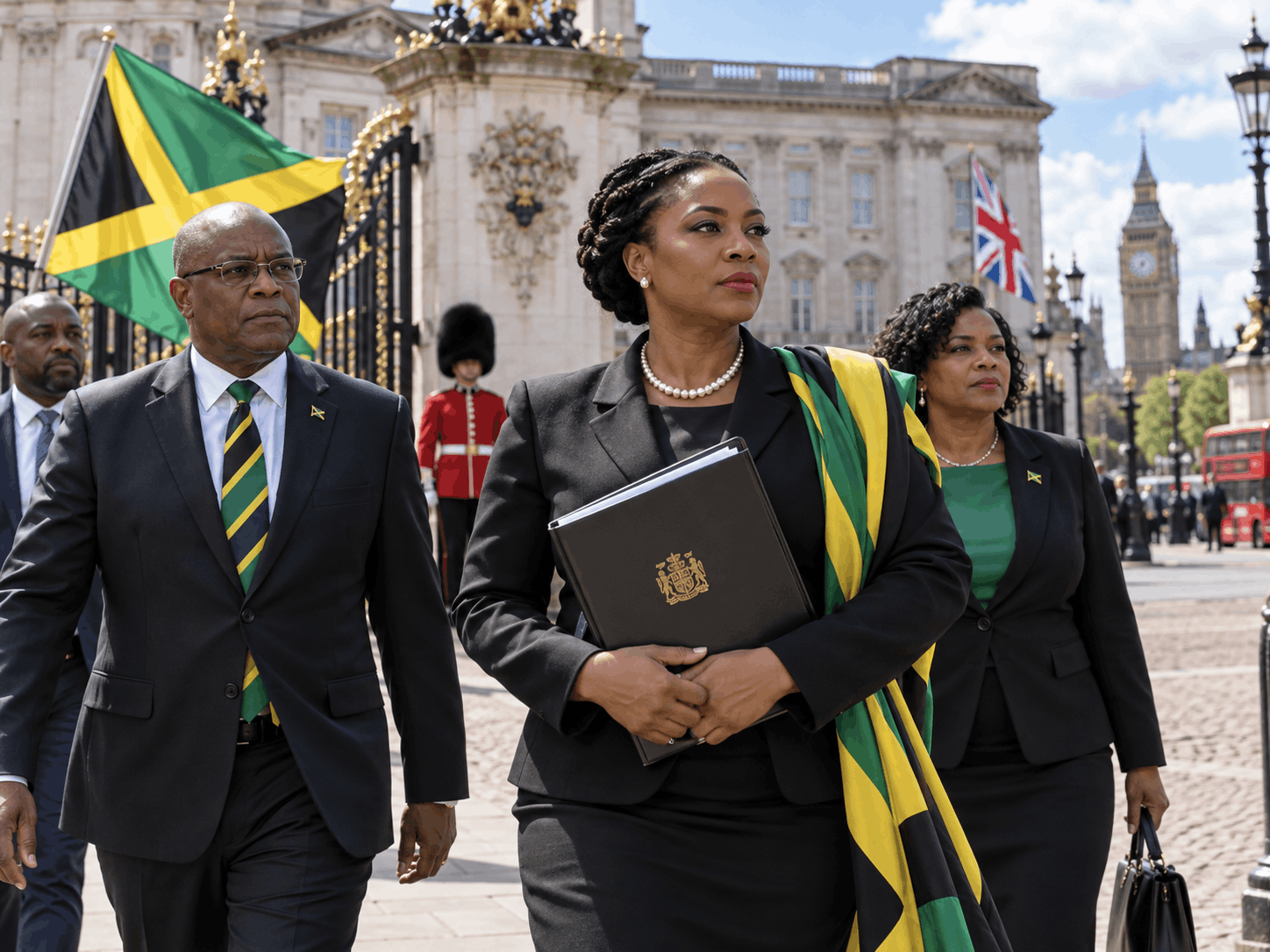
A Jamaican government delegation has arrived in Britain as the country takes a significant new step in its long-running campaign for reparations connected to slavery and colonial rule.
Led by Jamaica’s Minister of Culture, Gender, Entertainment and Sport, Olivia Grange, the delegation travelled to London to lodge a formal petition addressed to King Charles III, who remains Jamaica’s head of state.
The development immediately generated dramatic headlines on social media, with some posts claiming that Jamaica had arrived in Britain to hand the King a £7.6 billion bill for slavery.
That description, however, is not quite accurate.
WHAT JAMAICA IS ACTUALLY ASKING FOR
Jamaica’s government has made clear that the petition itself is not a direct demand for payment.
Instead, it asks King Charles III, in his constitutional capacity as Jamaica’s monarch, to refer a series of legal questions to the Judicial Committee of the Privy Council.
Those questions focus on whether the forced transportation and enslavement of Africans in Jamaica conflicted with English common law, whether the system amounted to crimes against humanity for which Britain bears responsibility, and whether Britain has a legal obligation to provide some form of remedy.
In other words, Jamaica is attempting to open a legal route through which the historical question of reparations might eventually be considered.
That is very different from Britain having agreed to write a cheque.
WHERE DOES THE £7.6 BILLION FIGURE COME FROM?
The figure widely circulating online is connected to Jamaica’s broader reparations campaign.
Recent reporting has placed Jamaica’s estimated claim at around US$10 billion, equivalent to roughly £7.6 billion.
But that figure should not be confused with the precise wording of the petition now being pursued in London.
The petition seeks legal consideration of responsibility and remedy. It does not simply instruct King Charles to hand over £7.6 billion.
THE KING CANNOT PERSONALLY DECIDE THE CASE
There is another important constitutional point.
Although the petition is addressed to King Charles III, the monarch does not simply decide whether Britain should pay Jamaica billions of pounds.
The King acts within a constitutional framework and on government advice.
The petition therefore enters a legal and governmental process rather than becoming a personal decision for Charles.
This also means that the dramatic image of a Jamaican delegation walking into Buckingham Palace and presenting the King with a £7.6 billion invoice is not an accurate representation of what is happening.
A HISTORY THAT CANNOT BE IGNORED
The historical background is deeply serious.
Britain played a major role in the transatlantic slave trade, while Jamaica became one of the most important plantation economies in the British Caribbean.
Hundreds of thousands of enslaved Africans were transported to Jamaica over generations and forced to work under brutal conditions, particularly on sugar plantations.
Slavery in the British Empire was abolished in the 19th century, but campaigners argue that the economic and social consequences of slavery and colonialism continued long after emancipation.
Supporters of reparations therefore believe that acknowledgment alone is insufficient and that former colonial powers should contribute financially to repairing historic damage.
King Charles himself has spoken publicly about the horrors and lasting impact of slavery, although neither he nor successive British governments have endorsed large-scale financial reparations.
THE ARGUMENT AGAINST BILLIONS IN COMPENSATION
The opposing argument is equally central to the modern political debate.
Critics ask whether British taxpayers living in 2026 should be required to pay billions of pounds for crimes committed centuries before they were born.
Britain and Jamaica have also maintained close relationships since Jamaican independence, including extensive migration, education, trade, diplomacy, tourism, investment and development cooperation.
Many Jamaicans have built successful lives in Britain, while generations of Jamaican families have become an important part of modern British society.
Critics of reparations therefore argue that contemporary relations between the two countries cannot simply be reduced to a financial debt calculated from events of the colonial era.
They also question how any theoretical reparations payment would be calculated, who would receive the money and whether billions paid to governments would necessarily improve the lives of ordinary citizens.
WOULD JAMAICA REALLY RECEIVE £7.6 BILLION?
At present, there is absolutely no guarantee of that.
Jamaica’s petition represents the beginning of a legal and constitutional argument — not the end of one.
Even if the questions were ultimately considered by the Judicial Committee of the Privy Council, that would not automatically mean Britain was ordered to make a payment.
Complex questions involving historical law, sovereign responsibility, limitation periods and international legal principles would all have to be considered.
The British Government has also historically resisted demands for financial reparations.
The chances of an immediate multibillion-pound settlement therefore appear remote.
A DEBATE THAT WILL NOT DISAPPEAR
Whatever one thinks of Jamaica’s claim, the wider reparations campaign is unlikely to disappear.
CARICOM nations have increasingly pushed the subject onto the international agenda, arguing that former European colonial powers should formally engage with Caribbean countries on reparatory justice.
Britain, meanwhile, continues to acknowledge the horrors of slavery while resisting the principle that modern taxpayers should fund enormous compensation packages.
That leaves the two sides separated by a fundamental question:
Can a modern nation inherit financial liability for injustices committed by earlier generations?
Jamaica believes the legal question deserves to be tested.
Britain may strongly disagree.
THE BOTTOM LINE
The viral headline claiming that Jamaica has arrived in Britain demanding £7.6 billion directly from King Charles III makes the story sound considerably simpler than it really is.
Jamaica has indeed taken an important reparations petition to Britain.
But Britain has not agreed to pay £7.6 billion.
King Charles has not personally been handed a £7.6 billion invoice.
And there is currently no guarantee that Jamaica will receive financial reparations at all.
For the moment, Jamaica has opened another chapter in one of the most difficult debates linking Britain and the Caribbean.
The argument now moves through the worlds of history, law, politics and national responsibility.
Whether it ever reaches the Treasury is another matter entirely.
WORLD OF 7 — THE WORLD, CONTINENT BY CONTINENT