
By Publisher Ray Carmen
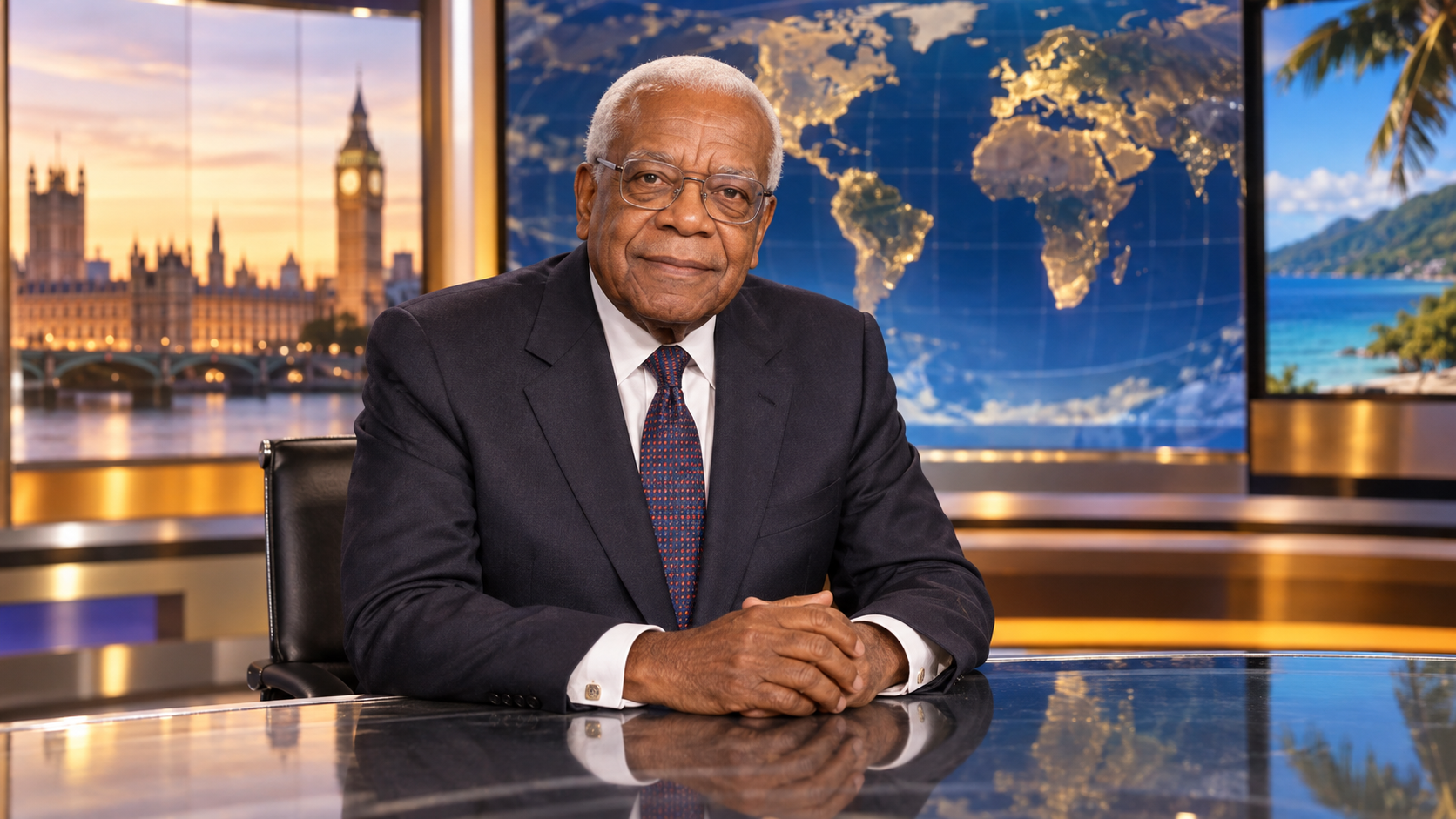
From Trinidad to the commanding desk of News at Ten, Sir Trevor McDonald changed the face of British broadcasting and became one of the most trusted journalists of his generation.
A PERSONAL TRIBUTE
I have had the privilege of knowing Sir Trevor McDonald for more than thirty years. Across those decades, one quality has remained constant: the dignity seen by millions on television is not a performance. It belongs to the man himself.
Sir Trevor is one of the rare figures whose career can be described as historic without exaggeration. He did not simply read the news. He carried the weight of events into British homes with clarity, restraint and humanity. He became a symbol of trust, and his success widened the horizon for generations of broadcasters who followed him.
For Caribbean World, his story carries a special pride. For WORLD OF 7, it is a genuinely global story: a young man from Trinidad who rose to become one of the defining voices of British public life.
FROM SAN FERNANDO TO LONDON
Trevor McDonald was born in San Fernando, Trinidad, on 16 August 1939. His broadcasting life began in the Caribbean, first through local journalism and then at Radio Trinidad and Trinidad Television, where he worked as a reporter, newsreader and sports journalist.
Those early years mattered. Caribbean broadcasting demanded versatility, discipline and a direct relationship with its audience. McDonald learned how to tell a story without unnecessary drama and how to allow the facts to carry their own force—qualities that would later become his signature.
He moved to London in 1969 to work for the BBC World Service at Bush House, producing programmes for audiences that included the Caribbean. Four years later, in 1973, he joined Independent Television News as a general reporter and became ITN’s first Black reporter.
BREAKING A BARRIER WITHOUT BEING CONFINED BY IT
The significance of that appointment cannot be separated from the Britain of the 1970s. Television newsrooms, like many national institutions, did not yet reflect the country they served. McDonald understood that he was crossing a barrier, but he resisted being reduced to a symbol or assigned only the stories that others imagined a Black journalist should cover.
His answer was excellence. He reported, travelled, mastered the language of diplomacy and international affairs, and earned authority through the quality of his work. The achievement was not simply that a Black journalist appeared on screen; it was that viewers came to judge him by the highest standard of journalism and found him exceptional.
That quiet advance changed British television. Representation became inseparable from credibility. A child watching at home could see that the person trusted to explain the most important events in the world might also come from the Caribbean.
THE FACE OF NEWS AT TEN
In November 1992, McDonald became the sole presenter of News at Ten. The famous chimes of Big Ben announced the bulletin, but it was his measured voice that steadied the nation through wars, elections, political upheaval, royal events, tragedy and change.
His style was controlled but never cold. He did not compete with the story. He understood that authority in broadcasting does not come from volume; it comes from preparation, precision and the confidence to pause. That economy made moments of emotion more powerful because they were never manufactured.
He also became known for interviews with leaders at the centre of world history. He secured the first interview with Nelson Mandela after Mandela’s release from prison and interviewed Saddam Hussein after Iraq’s invasion of Kuwait. These were encounters in which theatre could easily overwhelm substance. McDonald’s calm questioning kept the focus where it belonged.
BEYOND THE NEWS DESK
When the traditional News at Ten was removed from the schedule in 1999, Sir Trevor continued to lead major current-affairs coverage through Tonight with Trevor McDonald.
The programme carried his name because viewers associated it with seriousness and public purpose. He later returned to the revived News at Ten in 2008, a reminder that some broadcasters are not merely presenters of an institution; they become part of its identity.
His documentary work took him far beyond Westminster and the studio. He explored prisons, travel, crime, culture and the lives of people often seen only through headlines. In every setting, the essential method remained the same: observe carefully, ask plainly and treat the audience as intelligent.
His long association with cricket is equally fitting. Cricket links Britain and the Caribbean through history, rivalry, memory and joy. In Sir Trevor’s hands, the game becomes more than sport: it becomes a language of belonging.
HONOURS THAT RECOGNISE A NATIONAL INSTITUTION
Sir Trevor was appointed an OBE in 1992 and knighted in 1999 for services to broadcasting and journalism.
His many professional honours include the Royal Television Society Gold Medal, a National Television Award for Special Recognition, an RTS Lifetime Achievement Award and the BAFTA Fellowship awarded in 2011.
The awards are deserved, but they do not fully explain his place in the public imagination. That rests on something more fragile and more valuable: trust. For years, families stopped what they were doing when he appeared on screen because his presence signalled that the news mattered and would be delivered with care.
THE MEASURE OF THE MAN
Broadcasting has changed beyond recognition. The nightly bulletin now competes with alerts, algorithms, influencers and an endless tide of commentary. Yet the qualities Sir Trevor represents have become more necessary, not less: accuracy, proportion, courtesy, courage and an instinctive respect for the truth.
His legacy is visible in every newsroom that is more representative than the one he entered, in every young broadcaster who sees no contradiction between Caribbean heritage and British authority, and in every journalist who understands that trust is accumulated slowly and can be lost in a moment.
I salute a world-famous broadcaster, a Caribbean son and a British national treasure.
After more than thirty years of knowing Sir Trevor, I can say with conviction that the grace of the public figure is matched by the character of the man. His was not merely a remarkable career. It was a path opened for others.