
By Publisher Ray Carmen
Fidel Castro spent decades at the centre of world affairs. The Cuban revolutionary confronted American presidents, survived repeated attempts to remove him and became one of the most recognisable political leaders of the modern age.
Away from government, revolution and international conflict, however, Castro’s private life inspired an entirely different collection of stories.
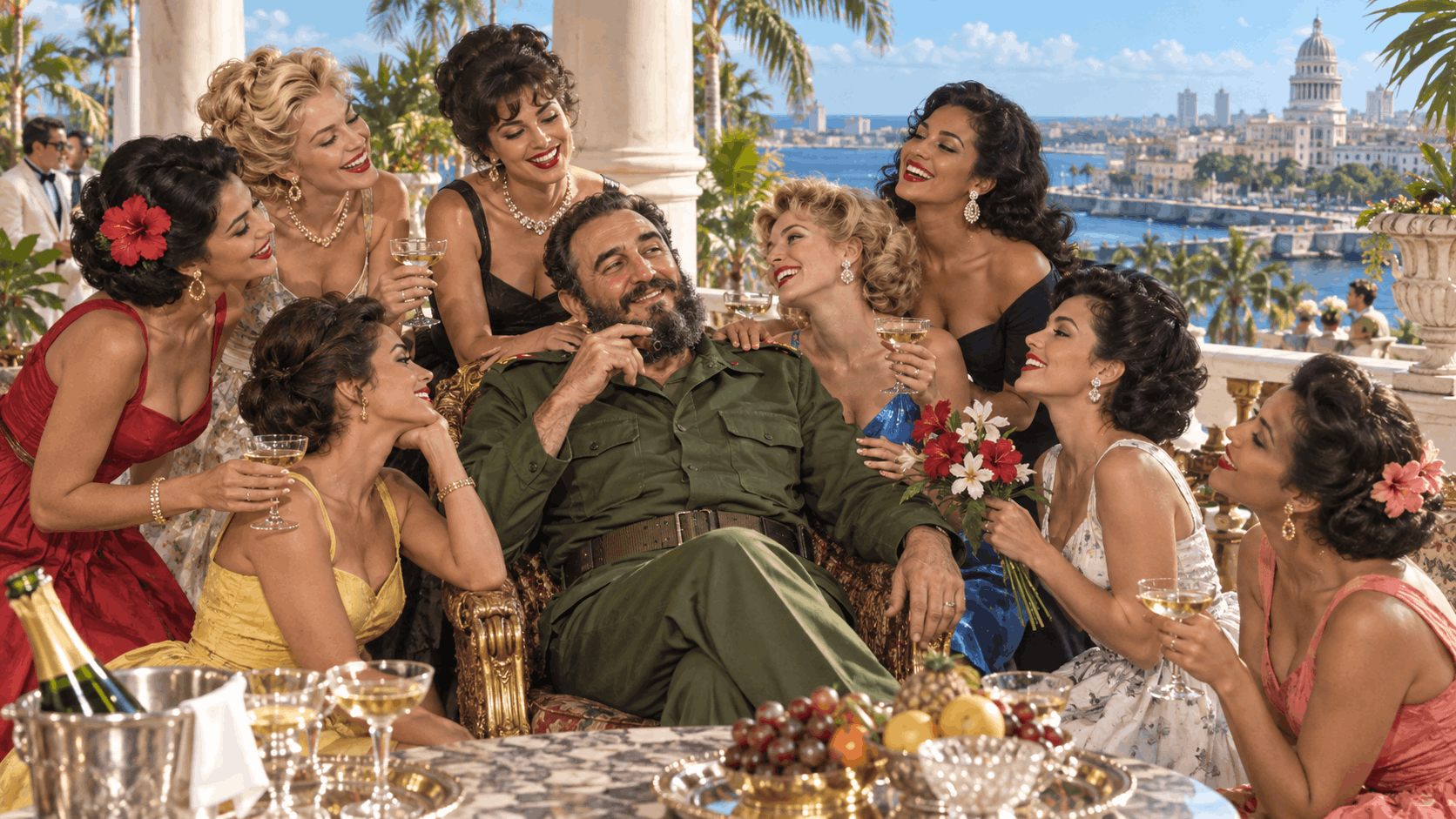
The most extraordinary came from a man identified as Ramon, who was described in published reports as a former official within Castro’s government. He alleged that the Cuban leader had intimate encounters with approximately 35,000 women during his lifetime.
According to Ramon’s account, Castro regularly met two women each day over a period of more than four decades. One encounter was allegedly arranged around lunchtime and another during the evening, with an occasional third meeting reportedly added in the morning.
The story reached an international audience in 2008 after being connected with a documentary project by filmmaker Ian Halperin. Newspapers and magazines subsequently repeated the claim, transforming it into one of the most sensational tales associated with Castro’s secretive personal world.
Former associates, bodyguards and women linked romantically with Castro have offered various accounts of a private existence hidden from ordinary Cubans. Their descriptions helped create the image of a leader whose personal privileges contrasted sharply with the disciplined revolutionary character projected in public.
Nevertheless, no surviving register, official document or independently verified collection of evidence proves that Castro had relationships with 35,000 women. The remarkable total is based principally upon attributed testimony and must be treated as an allegation rather than an established historical fact.
The numbers themselves invite scepticism. Maintaining such a pattern would have required an extraordinary and almost unbroken succession of encounters over several decades—even while Castro was governing Cuba, travelling overseas and navigating repeated political crises.
Perhaps that improbability explains the story’s enduring appeal. It adds another colourful layer to a man already surrounded by political controversy, assassination legends and tales of personal excess.
The precise truth may never be known. Fidel Castro maintained tight control over information concerning his family, companions and private routines, leaving historians to separate documented events from recollection, exaggeration and mythology.
What remains is an irresistible piece of Castro folklore: the suggestion that the revolutionary leader’s appetite for conquest may have extended considerably beyond the political arena.
If the remarkable account contained even a spark of truth, Castro’s celebrated Havana cigar was evidently not the only symbol of his astonishing stamina.