
The King tells some of the world’s most powerful technology figures that humanity must retain control of artificial intelligence before it is too late
By Publisher Ray Carmen
King Charles III has delivered a powerful warning to some of the world’s leading artificial-intelligence executives, urging them to ensure that the extraordinary technology now transforming society remains firmly under human control.
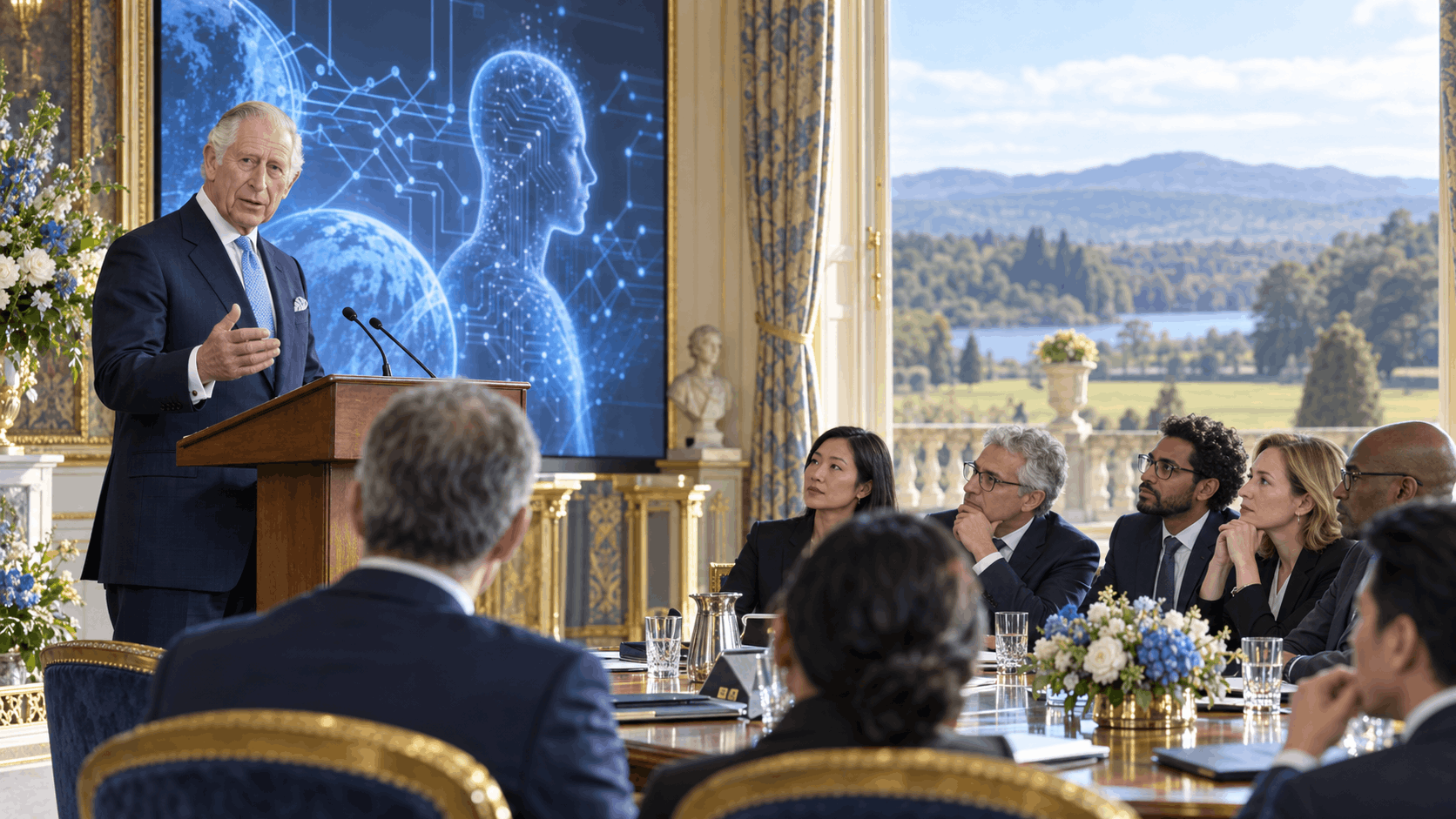
Speaking at a high-level gathering at Dumfries House in Scotland on 17 September 2026, the King brought together senior figures from Nvidia, Google DeepMind, OpenAI and Anthropic, alongside Britain’s Minister for Artificial Intelligence and specialists considering the ethical development of AI.
His message was striking: artificial intelligence possesses enormous potential to improve human life, but the world must also confront what he described as its “existential dangers” if increasingly powerful systems fall into the wrong hands or develop without adequate safeguards.
Charles acknowledged AI’s potential to transform medicine, science and other areas of human endeavour. But he also challenged the technology industry to consider whether sufficient mechanisms of control are being created quickly enough as the capabilities of AI accelerate.
The gathering included some of the most influential people shaping the new technological era. Nvidia chief executive Jensen Huang, Google DeepMind co-founder and chairman Sir Demis Hassabis, OpenAI chief financial officer Sarah Friar and UK AI Minister Kanishka Narayan were among those attending.
A QUESTION FOR HUMANITY
The King’s intervention goes far beyond computers, algorithms and corporate competition.
At its heart lies a question that governments, scientists and technology companies around the world are increasingly being forced to address:
Who ultimately controls artificial intelligence — humanity, or the machines humanity creates?
Charles called for AI development to proceed with “safety at its heart”, while encouraging greater international cooperation and consensus. He also emphasised the importance of ensuring that technological progress continues to serve people, communities and the natural world.
The debate has become increasingly urgent as AI systems grow more capable and as researchers, governments and technology companies debate how much regulation, independent testing and international oversight may be necessary.
There is no universal agreement that catastrophic outcomes are inevitable. Some technology leaders argue that artificial intelligence can continue to advance rapidly while rigorous safeguards, testing and responsible deployment are strengthened alongside it.
But the King’s message was unmistakable: the extraordinary opportunities created by AI should not blind the world to the responsibility accompanying them.
The decisions being made today may influence not simply the next generation of technology, but the society inherited by future generations.
Artificial intelligence could become one of humanity’s greatest tools.
The challenge is ensuring that it always remains a tool of humanity — rather than its master.
WORLD OF 7
ONE PLANET. 7 CONTINENTS. ONE WEEKLY GLOBAL VIEW.