
By Publisher Ray Carmen
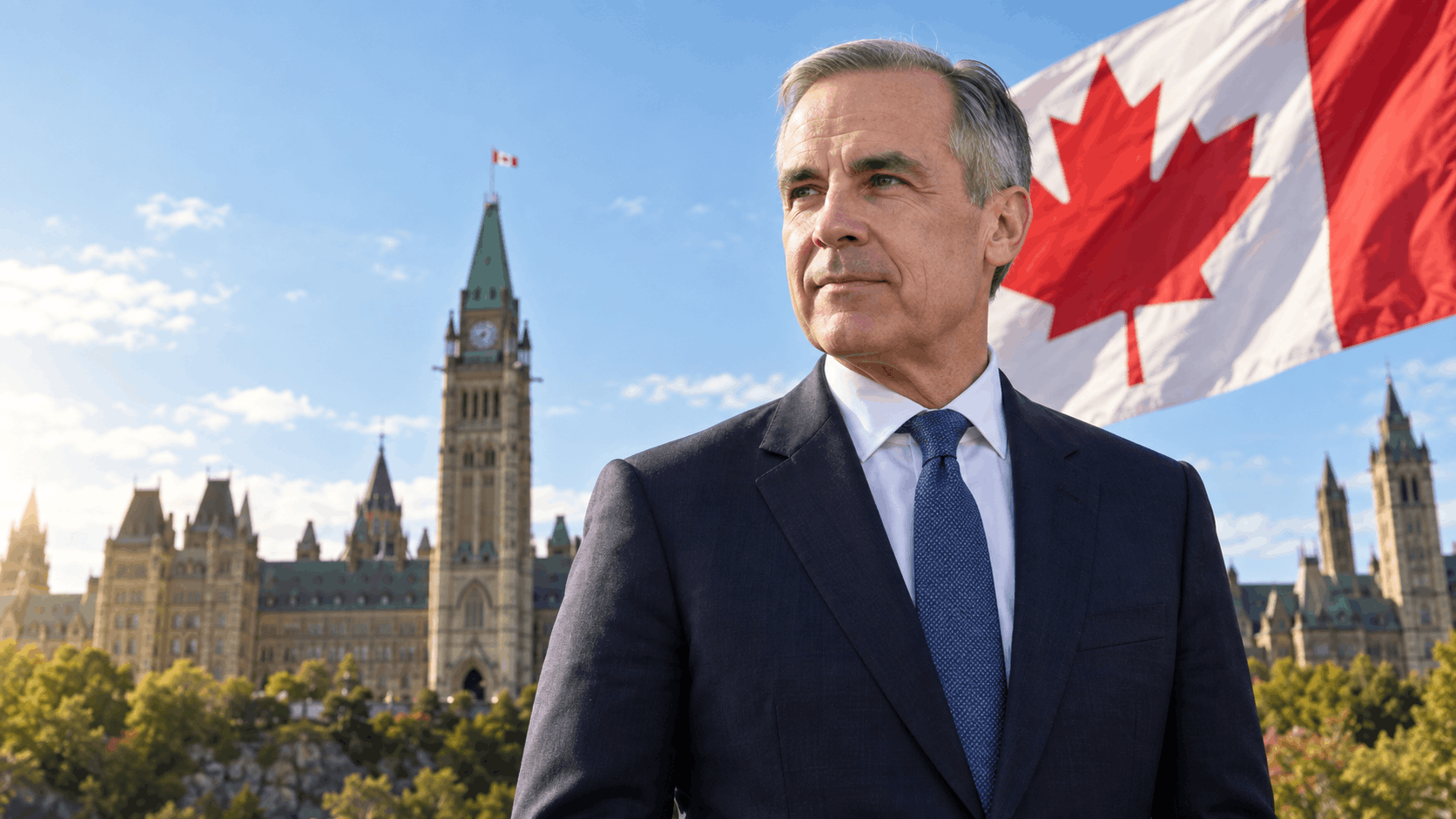
The phrase “Canada’s Churchill” has been circulating alongside imagery referring to TIME magazine and Mark Carney. However, as of publication, there is no verified official TIME announcement naming Carney its 2026 Person of the Year, so the comparison should be treated as commentary rather than an official TIME designation.
What is beyond dispute is that Mark Carney has become one of the most prominent figures in international politics during a period of considerable economic and geopolitical change.
FROM CENTRAL BANKER TO PRIME MINISTER
Carney did not enter politics through the conventional route.
Educated at Harvard and Oxford, he worked in international finance before becoming Governor of the Bank of Canada in 2008. In 2013, he became Governor of the Bank of England, serving until March 2020.
His career therefore placed him at the centre of major financial and economic events well before he entered elected politics.
Carney became Prime Minister of Canada in 2025 and has since sought to position Canada for a world in which traditional economic and security relationships are changing rapidly.
CANADA LOOKS BEYOND ONE BORDER
A central feature of Carney’s foreign-policy approach has been an effort to deepen Canada’s international partnerships while retaining its longstanding relationship with the United States.
Europe has become particularly important.
On 17 September 2026, Carney addressed the European Parliament in Strasbourg and argued for a significantly deeper Canada–European Union partnership. His speech highlighted cooperation in energy, critical minerals, defence, artificial intelligence, research, finance and technology.
European Commission President Ursula von der Leyen had opened discussion of Canada potentially becoming the EU’s first form of “associate member.” Carney welcomed the ambition for a closer relationship, although the precise meaning and legal structure of such an arrangement remain to be negotiated.
For Canada, the underlying objective is diversification.
The country remains deeply integrated economically with the United States, but Ottawa is increasingly looking towards Europe and other partners in areas ranging from defence and energy to advanced technology and critical minerals.
A NEW SECURITY DIRECTION
Canada has also formally applied to join the UK-led Joint Expeditionary Force, a rapid-response military partnership involving Northern European NATO countries.
The move forms part of Canada’s effort to broaden its defence relationships and increase cooperation with European allies.
Taken together, these initiatives suggest a Canadian government seeking a larger and more diversified international role.
WHY THE CHURCHILL COMPARISON?
Comparisons with Winston Churchill are inevitably imperfect.
Churchill’s political career was shaped by Britain, empire and the extraordinary circumstances of the Second World War. Carney is governing Canada in a very different century and confronting substantially different challenges — trade tensions, economic competitiveness, technology, energy security, defence spending and changing international alliances.
The comparison circulating around Carney therefore reflects political imagery more than historical equivalence.
Both figures have nevertheless been associated by supporters with the idea of national resolve during periods of uncertainty.
Whether that comparison ultimately lasts will depend on events and on how Canadians assess Carney’s record.
THE TEST IS DELIVERY
International speeches and diplomatic initiatives represent only part of Carney’s task.
At home, his government faces questions surrounding housing affordability, economic growth, productivity, immigration capacity, public services, energy development, regional interests and government finances.
Those domestic issues are likely to play a major role in determining how his premiership is eventually viewed.
Canada’s growing engagement with Europe may create new commercial and strategic opportunities, but converting diplomatic announcements into investment, employment and measurable economic benefits will be the longer-term test.
PERSON OF THE YEAR?
The social-media material that prompted this WORLD OF 7 feature presented Mark Carney alongside the description “Person of the Year” and the phrase “Canada’s Churchill.”
At the time of publication, WORLD OF 7 has not verified an official TIME announcement naming Mark Carney its 2026 Person of the Year.
For that reason, we credit the circulating description as the inspiration for this feature rather than presenting it as an official TIME award.
What can be documented is that Carney is pursuing a substantial reorientation of Canada’s relationships with Europe and other partners during a period of significant international change.
Whether history eventually attaches a grand comparison to his premiership is a question for Canadians — and for history itself.