
By Publisher Ray Carmen
Few cities in the world carry the weight of history quite like Jerusalem.
Its ancient stone walls, narrow streets, places of worship and generations of human stories have made it one of the most photographed and filmed cities on Earth. Yet behind the famous skyline lies another Jerusalem — one discovered not through monuments alone, but through the lives of the people who call the city home.
For the documentary filmmaker, Jerusalem presents an extraordinary canvas.
The camera moves beyond the postcard view and into the everyday: a shopkeeper preparing for another morning, children walking through ancient streets, families gathering around a table, craftspeople continuing traditions passed down through generations, and worshippers making their way quietly towards sacred places.
This is Jerusalem through a more human lens.
A CITY WHERE EVERY STONE HAS A STORY
Walk through Jerusalem and centuries appear to coexist within a few footsteps.
Ancient walls stand beside modern neighbourhoods. Market stalls overflow with colour and conversation. Church bells, calls to prayer and the sounds of daily city life form part of a landscape shaped by Judaism, Christianity and Islam.
For a filmmaker, the fascination is not simply in recording what Jerusalem looks like.
It is in capturing what Jerusalem feels like.
Light falling across old limestone. The expression on an elderly resident’s face. A child disappearing into a crowded lane. The quietness of an early morning before the streets fill again.
These small moments can sometimes reveal more about a place than the grandest panoramic shot.
THE PEOPLE BEHIND THE LANDMARKS
Jerusalem’s famous landmarks have been photographed millions of times.
But documentary storytelling asks a different question:
Who are the people living beyond the picture?
The strongest films about cities often begin with ordinary lives.
A baker opening his doors before sunrise. A musician practising behind an open window. A grandmother remembering the Jerusalem of her childhood. A young artist trying to build a future while surrounded by the physical evidence of the past.
Through their stories, history becomes personal.
The city stops being merely a destination and becomes a collection of human experiences.
FILM AS A BRIDGE
At its best, documentary filmmaking does more than record events.
It listens.
A camera can cross boundaries that words sometimes cannot. It can introduce audiences thousands of miles away to another person’s daily reality, preserving their voice, traditions and memories.
In a city as complex and internationally significant as Jerusalem, that responsibility becomes particularly important.
The most powerful filmmaker is not necessarily the one who speaks the loudest, but the one prepared to observe carefully and allow people to tell their own stories.
There is dignity in that approach.
There is also hope.
BEYOND THE HEADLINES
For much of the outside world, Jerusalem is frequently encountered through news reports and political debate.
But a city is always larger than its headlines.
There are friendships, businesses, schools, restaurants, artists, families, celebrations, faith, music, food and countless ordinary moments taking place every day.
Documentary film has the ability to preserve those quieter dimensions.
It reminds us that behind every historic location are individuals with ambitions, memories, worries, humour and dreams for the future.
That may ultimately be Jerusalem’s most compelling story.
Not simply the story of what happened here centuries ago — but the story of the people living here today.
THROUGH HER LENS
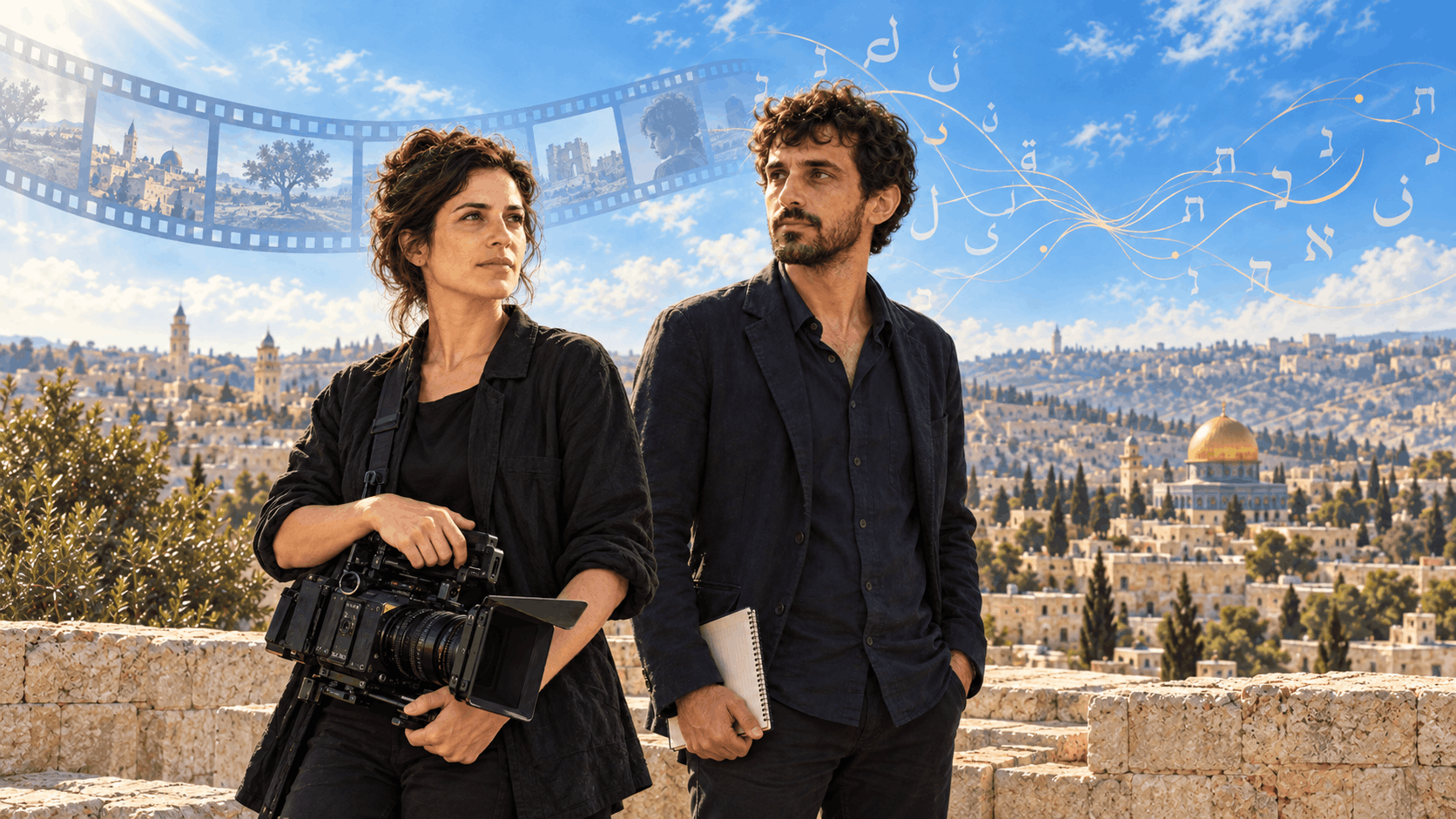
Standing above the city with a camera in her hands, the filmmaker is therefore doing more than searching for the perfect shot.
She is searching for connection.
Every frame becomes part of a larger portrait: people, culture, heritage and hope.
Jerusalem has been interpreted by historians, archaeologists, religious scholars, politicians, writers and travellers for generations.
Yet there will always be another story waiting around the next corner.
Another face.
Another memory.
Another perspective.
And another opportunity for the camera to remind the world that even within one of humanity’s most ancient cities, the most important stories are often remarkably simple.
They are stories about people.
Jerusalem — through her lens.
A city of stories. A more human tomorrow.