 13 February 2026

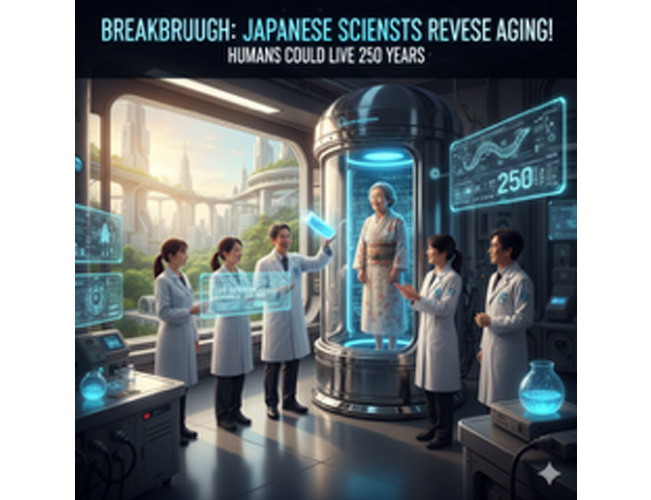
A bold headline has been making the rounds on Instagram:
“Japanese Scientists reversed aging and now humans could live 250 years.”
It sounds like science fiction — but what is really happening in Japan’s cutting-edge laboratories?
The Reality Behind the Claim
Japan is a global leader in longevity research. With the highest concentration of centenarians on Earth, the country has invested heavily in anti-aging science, regenerative medicine, and cellular repair.
Current research focuses on:
-
Stem cell regeneration
-
Telomere extension (protective caps on DNA that shorten with age)
-
Senescent cell removal (“zombie cells” that accelerate aging)
-
Genetic reprogramming techniques
Experimental treatments in animals have shown promising results — reversing certain cellular markers of aging and improving tissue repair. Scientists have successfully “rejuvenated” cells in laboratory settings, effectively resetting parts of their biological clock.
But here’s the key point:
No verified human study has shown that humans can live anywhere near 250 years.
Why 250 Years Is Unlikely (For Now)
Human lifespan depends on a complex mix of genetics, environment, disease resistance, and cellular stability. Extending life to 250 years would require:
-
Preventing cancer indefinitely
-
Maintaining brain function for centuries
-
Protecting DNA from cumulative damage
-
Avoiding organ degradation
We are not there — yet.
What Is Real?
The exciting reality is this: longevity science is moving fast. Artificial intelligence is helping decode aging pathways, and clinical trials for anti-aging drugs are underway globally.
Japan is at the forefront of this revolution. While 250 years is currently science fiction, living well beyond 100 in good health is becoming increasingly plausible.
The Bigger Question
Perhaps the more profound question is not how long we can live — but how well.
If science extends healthy lifespans to 120, 150, or even 180 years, society itself would transform:
-
Retirement would be redefined
-
Education would span decades
-
Relationships and legacy would take on new meaning
Longevity is not just a medical breakthrough — it is a philosophical revolution.
Final Word
The Instagram headline is exaggerated.
The science behind it, however, is very real — and quietly extraordinary.
The age of radical longevity has begun.
Two hundred and fifty years? Not yet.
But the future of human life is stretching further than ever before.
And that, my dear readers, is a story worth telling.