 13 December 2025

By Publisher Ray Carmen
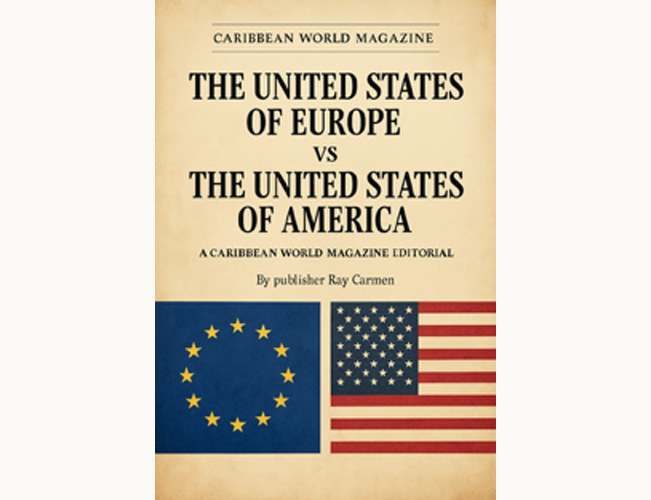
For decades, two towering giants have dominated the Western political landscape: the United States of America — bold, brash, influential — and the European Union, often quieter but increasingly coordinated, increasingly ambitious, and increasingly confident. Many analysts now speak of the EU not simply as a union, but as “The United States of Europe.”
Yet as the world enters a new era of political turbulence, one thing is clear:
The transatlantic partnership is no longer what it used to be.
America’s Shift: The New Transatlantic Chill
Since the rise of Donald Trump and his return to the centre of Republican politics, a distinctly anti-European tone has emerged in U.S. discourse. Trump and his closest allies have repeatedly accused European nations of:
-
Not paying their “fair share” in NATO
-
Being overly dependent on U.S. military protection
-
Undermining American industry through environmental and trade regulations
-
Failing to support U.S. positions on China, Russia, and global security
What was once a powerful, unquestioned alliance is now tested by a wave of American inwardness, driven by populist rhetoric, economic competition, and a desire to pull back from global commitments.
To Europe, the message coming out of Trump-world is clear:
“You’re on your own.”
A New Europe Rising: From Union to Power Bloc
If the U.S. is pulling back, Europe is quietly doing the opposite.
Brussels is pursuing deeper integration, stronger borders, and a more assertive geopolitical role. With new defence frameworks, joint military spending, and greater cooperation in energy, transport, climate, and technology, the EU is slowly evolving from alliance to power bloc — a near-superpower in everything but name.
Some European leaders even whisper openly:
“If America can be a superpower, why not Europe?”
Key areas where Europe is gaining strength:
1. Defence & Security Integration
The EU now discusses a joint European army — once unthinkable — as trust in U.S. guarantees becomes uncertain.
2. Economic Unity
The EU is the world’s largest trading bloc and the second-largest economy after the U.S., with a shared regulatory system so influential it’s known as “the Brussels Effect.”
3. Energy Independence
The continent’s rapid shift away from Russian fossil fuels has ignited a new era of green energy innovation, making Europe a global leader in sustainable power.
4. Technological Sovereignty
With AI laws, digital markets regulation, and semiconductor strategy, the EU is positioning itself as the world’s rule-maker in tech.
This is no longer the fragmented Europe of the past — this is a region preparing to stand tall.
A Clash of Philosophies, Not Just Politics
At the heart of this growing divide lies a clash of worldviews:
-
America, with its frontier spirit, sees global leadership as transactional.
-
Europe, shaped by centuries of war, sees cooperation and rules as the path to peace.
Trump’s America questions alliances.
Europe strengthens them.
America pursues power through dominance.
Europe pursues power through unity.
This difference — philosophical, structural, cultural — is why the rift feels so deep.
What It Means for the Rest of the World — Especially the Caribbean
For small states like those in the Caribbean, the tension between Washington and Brussels is not just a headline — it’s a geopolitical shift that affects:
-
Trade agreements
-
Climate financing
-
Tourism flows
-
Food imports
-
Digital and aviation regulation
-
Diplomatic support in global forums
Historically, the Caribbean relied heavily on British and American influence. But with the U.S. more inward-looking and Europe more assertive, a new dynamic emerges:
Europe is becoming a consistent partner. The U.S. an unpredictable one.
This could redefine investment, aid, and trade in the region for years to come.
Are We Watching a New Cold War of Influence?
Not a military one — but a diplomatic and economic rivalry where two Western giants compete for global leadership, soft power, and moral authority.
Both claim to stand for democracy.
Both claim to defend global order.
Both believe in their way of doing things.
But the truth is simple:
There can’t be two suns in the same sky.
The United States of Europe and the United States of America are drifting toward a strategic contest — subtle for now, but unmistakable.
Final Word
In a world reshaped by conflict, technology, climate pressure, and political upheaval, the Western alliance is no longer carved in stone.
America is questioning its allies.
Europe is building new muscle.
And for the first time in modern history, the question feels very real:
Will the future belong to the American way — or the European one?
Whatever the answer, the Caribbean — and the world — will be watching.