 17 March 2026

By Publisher Ray Carmen
Few figures in modern history command the universal reverence earned by Mahatma Gandhi. To millions he was Bapu — “Father.” To the wider world he was the quiet revolutionary who proved that moral courage could overcome the mightiest empire.
Born in 1869 in the coastal town of Porbandar in western India, Gandhi began life as an unassuming lawyer. Yet destiny had larger plans. During his years in South Africa, he witnessed the brutal reality of racial discrimination against Indians. It was there that he forged the philosophy that would change the course of history — Satyagraha, the power of truth and non-violent resistance.
When Gandhi returned to India in 1915, the subcontinent was still under British colonial rule. Armed not with weapons but with conviction, he began mobilising ordinary people — farmers, labourers, women and students — in a peaceful struggle for dignity and freedom.
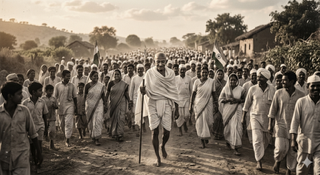
One of the most iconic moments of that struggle came during the Salt March of 1930. In a symbolic act of defiance against British salt taxes, Gandhi walked more than 240 miles to the Arabian Sea, gathering thousands of followers along the way. The march electrified the nation and captured the imagination of the world.
His message was radical in its simplicity: violence breeds violence, but truth and non-violence possess a moral power that ultimately triumphs.
Gandhi’s influence reached far beyond India. Leaders of social justice movements across the globe drew inspiration from his teachings. Among them was Martin Luther King Jr., who applied Gandhi’s principles to the American civil rights movement, and Nelson Mandela, who acknowledged Gandhi’s philosophy in the struggle against apartheid in South Africa.
Yet Gandhi was not merely a political strategist. He was a moral voice. Clad in simple homespun cloth, he championed humility, religious tolerance and the unity of all humanity. At a time when the world was torn by wars and ideological battles, Gandhi stood as a reminder that conscience could still guide politics.
India finally achieved independence in 1947. Tragically, Gandhi did not live long to see the fruits of his life’s work. In January 1948 he was assassinated in New Delhi, an act that shocked the world and plunged millions into grief.
But while the man fell, the message endured.
Today Gandhi’s legacy continues to resonate across continents and generations. From civil rights campaigns to peaceful protest movements, his belief in non-violence remains a guiding light for those who seek justice without hatred.
In a century often marked by conflict and division, the life of Mahatma Gandhi reminds us of a timeless truth: that the greatest revolutions are not fought with weapons, but with courage, compassion and the unyielding power of truth.
The world did not merely admire Gandhi.
It loved him , and continues to do so.