 1 April 2026

By Publisher Ray Carmen
The fall of Nicolás Maduro was never going to be quiet.
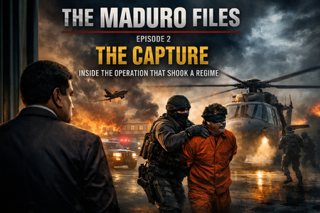
If Episode 1 captured the shock of a leader’s dramatic collapse—from presidential palace to courtroom—Episode 2 goes deeper, into the shadows where power truly operates.
Because leaders don’t simply fall.
They are cornered, isolated… and then taken.
A Regime Under Pressure
For years, Maduro’s grip on Venezuela appeared unshakable.
Backed by loyal military factions, intelligence networks, and strategic alliances with global powers, his administration weathered:
-
Crushing economic sanctions
-
International isolation
-
Growing domestic unrest
But beneath the surface, the pressure was building.
And then—something shifted.
The Moment Everything Changed
According to geopolitical analysts and intelligence-linked sources, any operation of this magnitude would not begin with force—but with silence.
Communications disrupted.
Movement restricted.
Trusted allies… suddenly unreachable.
In modern power struggles, the first strike is rarely visible.
It is control.
Phase One: Isolation
The objective is simple—cut the head off the command structure without triggering chaos.
This means:
-
Severing secure communication lines
-
Disrupting military coordination
-
Limiting access to loyalist units
A leader without communication is not in control.
He is alone.
Phase Two: Fracture From Within
No external move succeeds without internal weakness.
History shows that turning points come when:
-
Senior military figures hesitate
-
Political allies disappear
-
Inner-circle loyalty begins to crack
In such moments, power doesn’t collapse from the outside.
It collapses from within.
Phase Three: The Extraction
Then comes the decisive moment.
Fast. Controlled. Highly coordinated.
Whether by internal forces or external cooperation, the removal of a sitting leader must happen with precision—designed to avoid:
-
Civil unrest
-
Military retaliation
-
International escalation
It is not just an operation.
It is a message.
The World Is Watching
No event of this scale exists in isolation.
Global powers—including United States, Russia, and China—all have strategic interests in Venezuela’s future.
Any removal of power sends shockwaves through:
-
Energy markets
-
Regional stability
-
Global diplomacy
This is not just about one man.
It is about the balance of power.
From Power to Prosecution
Once removed, the battlefield changes.
Politics gives way to law.
And in that arena, figures like Barry Pollack become central to the story.
Known for handling complex, high-stakes international cases, Pollack represents the kind of legal firepower required when a case moves beyond borders and into history.
Because this is no ordinary defence.
This is:
-
A battle over jurisdiction
-
A fight over narrative
-
A test of international law itself
In a courtroom, power is no longer enforced—it is argued.
A Defining Question
The idea of a leader being captured raises a question the world is still grappling with:
Who decides when power ends?
Is it the people?
The military?
Or the international system?
More Than a Moment
Episode 2 is not just about “the capture.”
It is about the mechanics behind it—the invisible forces that determine how power is lost, transferred, and ultimately judged.
Because in today’s world, power doesn’t just fall.
It is engineered.
COMING NEXT — EPISODE 3