 15 May 2026

Washington and Beijing Edge Toward a New Global Conversation
By Publisher Ray Carmen
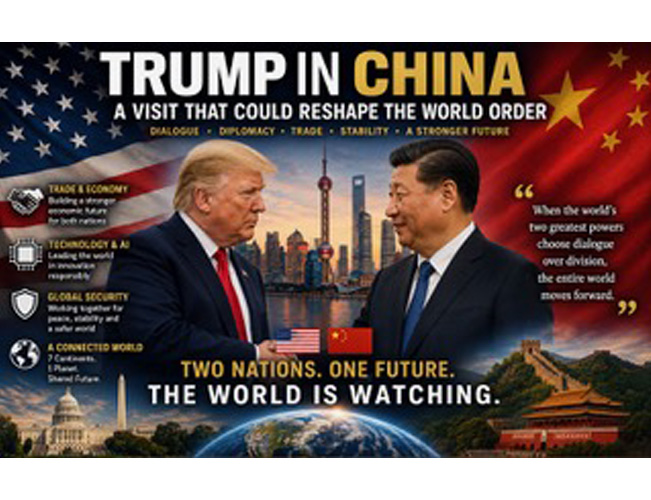
When the President of the United States steps onto Chinese soil, the world watches carefully. But when that President is Donald Trump, every handshake, every smile, every pause becomes part of a much larger geopolitical drama.
Reports surrounding a possible or future high-level Trump visit to China have already ignited intense global discussion — not simply because of diplomacy, but because the relationship between Washington and Beijing now sits at the very centre of the modern world order.
From trade wars and technology battles to Taiwan, artificial intelligence, military influence, energy, manufacturing and global finance — the United States and China are no longer merely competitors. They are two giants attempting to define the future of the planet itself.
At the centre of this unfolding story stands Xi Jinping — China’s most powerful leader in decades — facing a returning Trump administration determined to project American strength while simultaneously exploring the possibility of strategic economic stability.
For global markets, the symbolism alone would be enormous.
A Trump visit to Beijing would instantly dominate headlines across the seven continents. Investors would analyse every sentence. Diplomats would examine every photograph. Military analysts would study body language. Even the smallest gesture could send signals through stock exchanges, oil prices and international alliances.
Yet beyond the politics lies something even larger: reality.
The world’s two biggest economic powers remain deeply connected. American companies rely heavily on Chinese manufacturing, while China continues to depend on access to Western markets and financial systems. Despite years of tension, neither side can easily walk away from the other.
That is why many analysts believe any future Trump-China engagement would likely focus on three major areas:
- Trade and tariffs
- Technology and artificial intelligence
- Global security and economic stability
Behind closed doors, discussions could involve semiconductor restrictions, rare earth minerals, military positioning in the Pacific, supply chains, energy security and the future of global currency dominance.
And then there is the human theatre of it all.
Trump and Xi represent two completely different political systems, two different leadership styles and two very different visions of power. Yet both men understand media optics, symbolism and the importance of projecting authority to the world.
The images alone would become historic.
A state banquet in Beijing.
Red carpet ceremonies.
Rows of Chinese and American flags.
Global cameras capturing two of the most powerful men alive sitting across a negotiating table that could influence the next decade of humanity.
Supporters of renewed engagement argue that dialogue between great powers is essential to avoiding dangerous escalation. Critics, however, warn that relations remain fragile and that deep mistrust still exists on both sides.
Either way, one thing is certain:
If Trump visits China, it will not merely be another diplomatic trip. It will be one of the most watched political encounters on Earth.
Because when America and China speak directly to one another, the entire world listens.