 16 July 2026

By Publisher Ray Carmen
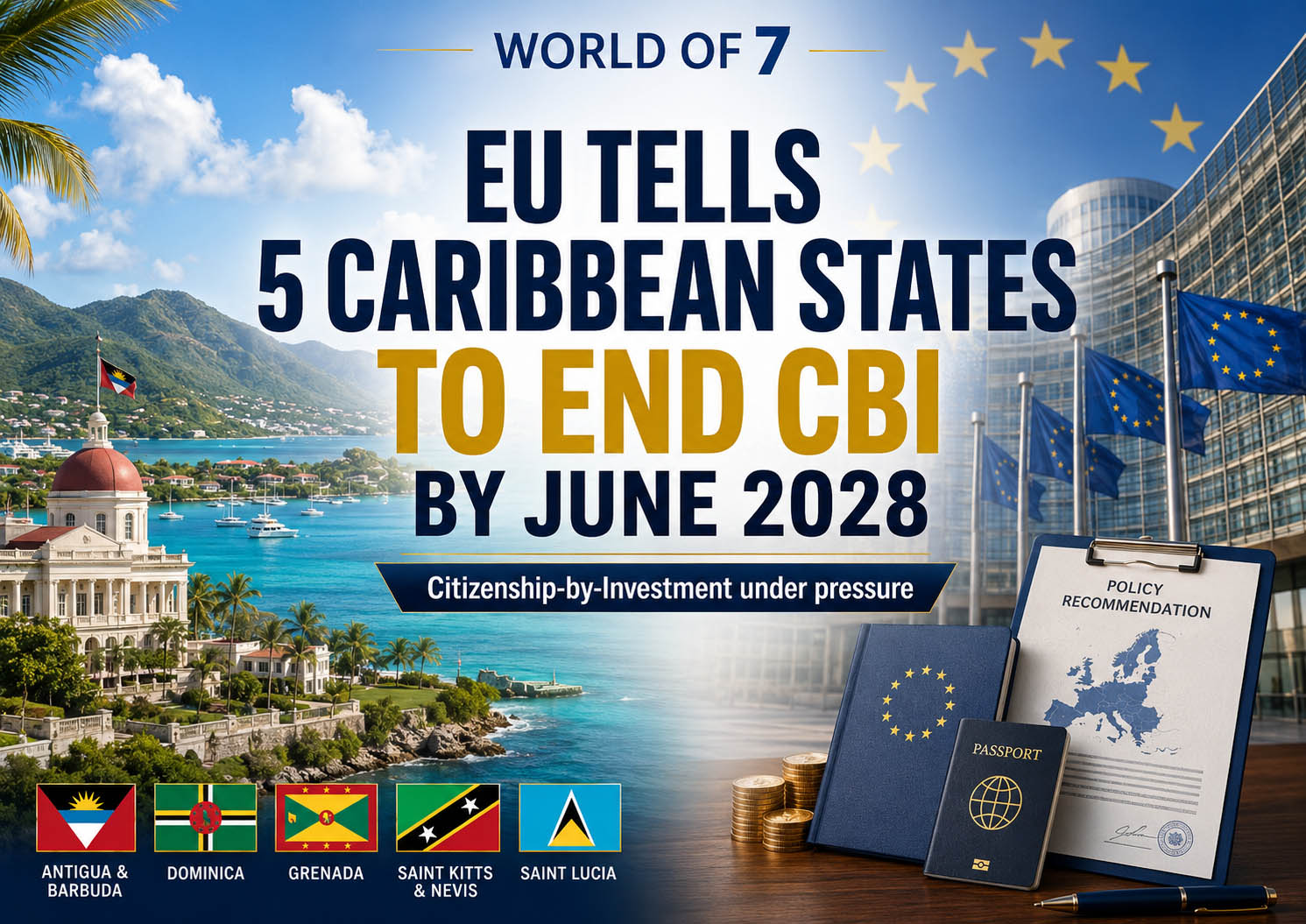
The European Commission has dramatically increased pressure on five Eastern Caribbean governments by formally requesting that they phase out their Citizenship by Investment programmes by 1 June 2028.
The countries affected are Antigua and Barbuda, Dominica, Grenada, Saint Kitts and Nevis, and Saint Lucia — five small island states that have relied heavily upon Citizenship by Investment revenues to fund national development, infrastructure, climate resilience and essential public services.
Under these programmes, approved foreign investors can obtain citizenship after making a qualifying financial contribution or investment and passing the required security and due-diligence checks.
The European Commission’s position is that the continued operation of an investor citizenship programme can now provide grounds for suspending a country’s visa-free access to the Schengen Area, particularly where citizenship is granted without what the European Union considers to be a sufficiently genuine connection to the country concerned.
The Commission has reportedly offered a 24-month transition period and requested additional interim safeguards, including enhanced vetting and the exclusion of applicants who are subject to European Union sanctions.
However, the Caribbean governments are unlikely to surrender these programmes without a serious diplomatic and economic struggle.
Antigua and Barbuda’s Prime Minister, Gaston Browne, has already made it clear that his Government regards Citizenship by Investment revenue as a critical pillar of the national economy. He has argued that such income cannot simply be removed unless credible replacement revenues and development assistance are placed on the table.
That argument deserves to be heard.
Small Caribbean nations have limited tax bases, relatively small domestic markets and exceptional exposure to hurricanes, climate change, global recessions and sudden collapses in tourism. For several governments, Citizenship by Investment has provided revenue for schools, hospitals, infrastructure, disaster recovery and national development.
At the same time, Europe is entitled to protect the integrity of its borders and visa-free travel arrangements. Citizenship cannot be allowed to become an unchecked commercial commodity, and every applicant must face rigorous international security, financial and criminal-background investigations.
The five Caribbean states have already attempted to address these concerns through regional reforms. The Organisation of Eastern Caribbean States has announced plans for stronger common regulation, biometric data collection, enhanced due diligence, regional registers, greater transparency and a minimum investment threshold of US$200,000.
The central question is therefore not simply whether Citizenship by Investment should exist.
The real question is whether Europe and the Caribbean can negotiate a framework that protects European security while respecting the sovereignty and economic survival of small island nations.
The Commission may possess the power to threaten the withdrawal of Schengen visa-free access. But the Caribbean governments also possess the sovereign right to decide how their economies should be financed and developed.
What must now follow is serious negotiation — not political intimidation.
If these programmes are ultimately brought to an end, Europe and the wider international community should help create realistic replacement investment, climate financing and development revenue.
Otherwise, the people who will bear the greatest cost will not be wealthy international investors.
They will be the ordinary citizens of five vulnerable Caribbean nations.
WORLD OF 7 — THE WORLD, CONTINENT BY CONTINENT.